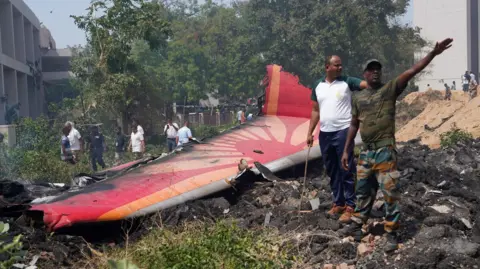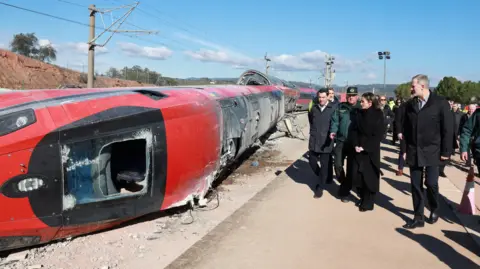
On Sunday, a high-speed train crash in southern Spain, the worst in over a decade, has been a devastating tragedy for the country, with the loss of at least 42 lives.
Amid the grief, many are asking what could have caused such a failure on one of Europe's most admired rail systems.
The CIAF rail investigatory commission has started analysing why a train travelling north from Málaga was derailed on a straight section of the route, causing it to collide with an oncoming train, which was also derailed.
The Spanish government has described the accident as extremely strange.
Three bodies already located in the wreckage were recovered on Tuesday afternoon, and a 42nd victim was also found at the crash site near Adamuz.
The shock felt in this sleepy town has been compounded by confusion at how a rail route that ran efficiently for so long suddenly failed.
After its inauguration in 1992, Spain's high-speed rail, or AVE, network was seen as a symbol of the country's modernisation. Built with EU funds, it provided a state-of-the-art transport system that was fast, efficient and safe.
A derailment near Santiago de Compostela in 2013 that killed 80 people was not part of the AVE network, although that train was travelling at high speed. Sunday's collision, however, took place on the oldest AVE route, that which connects Madrid with Andalusia.
Several officials, including the president of Renfe, the national rail operator, Álvaro Fernández Heredia, stated that human error was almost certainly not the cause of the accident, given that neither train was travelling at an excessive speed. Interior Minister Fernando Grande-Marlaska insisted that sabotage was not a possible cause.
The investigation continues, diving deep into the train that derailed, owned by Italian firm Iryo, which was manufactured in 2022. Transport Minister Óscar Puente noted that carriage number six would receive special scrutiny, as it was the first to derail and it offers many pieces of the puzzle.
Nonetheless, the revelation that part of the track at the crash site was broken has encouraged speculation that this might be the culprit, although the government warns that the track may have been damaged by the collision.
The investigation team also indicates they are examining the section of track where the derailment occurred, intending to analyze parts of it in a laboratory.
Adif, the rail infrastructure administrator, has been vocal about technical issues along the line over the last year, raising concerns about the signalling on the stretch where the collision took place.
Spain is now in a state of reflection and mourning, led by Prime Minister Pedro Sánchez, who promised absolute transparency as they uncover the reasons behind the tragedy. Only time will tell what this investigation reveals about the future of Spain's high-speed rail network.