In brief
Spanish rail authorities have implemented a temporary speed limit of 80 km/h (50 mph) on part of the high-speed line between Madrid and Barcelona due to a crack detected in the track. This decision comes in the wake of a recent high-speed train collision that resulted in 45 fatalities and significant disruptions in local rail services. The Transport Minister assured that the fault does not pose a danger to trains on the line as investigations continue into the broader safety of the rail system. Measures are being taken as the Rodalies service in Catalonia faces challenges amidst safety reviews and operational disruptions.
Spanish rail authorities have temporarily reduced the speed limit on part of the high-speed line between Madrid and Barcelona after a fault was detected on the track.
Transport Minister Óscar Puente said a crack had been found on Sunday night in the line 110km (68 miles) west of Barcelona, between Alcover and l'Espluga de Francolí, in the Catalonia region.
It comes days after a high-speed collision killed 45 people in southern Spain and amid severe disruption to local rail services in the north-east of the country.
The transport ministry said the fault in the line did not pose a danger to trains travelling along it and that they would continue to move along it.
This is the latest and most drastic of several speed reductions on high-speed lines in recent days, following the accident in Adamuz, in Andalusia, earlier this month.
The speed limit on the section of track affected will be 80km/h (50mph) until further notice. High-speed trains travel as fast as 300km/h between Madrid and Barcelona - one of Spain's most heavily used long-distance links.
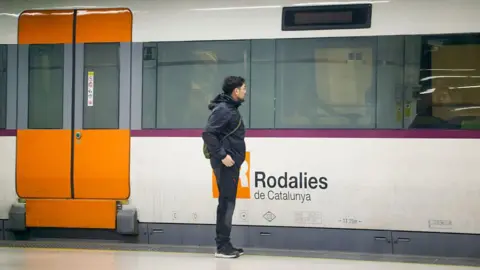
Meanwhile, the local Rodalies rail service in Catalonia has been severely disrupted. Last week, a trainee driver was killed when a train struck a collapsed wall.
On Monday, two separate incidents caused further chaos in the region. The Spanish government said it did not know the cause of the incidents but did not rule out a cyberattack.
The Catalan Republican Left (ERC) party said the Rodalies network had suffered 'decades of lack of investment', and socialist Prime Minister Pedro Sánchez is due to appear before Congress on 11 February to be questioned about the rail crisis.
Investigations continue into the Adamuz high-speed crash, where a 40cm (16in) section of track broke, leading to a tragic collision. Political pressure mounts as calls for the resignation of the Transport Minister arise, accusing him of misleading the public about safety measures.
}