The cosmos is buzzing with excitement as Comet C/2024 G3 (Atlas) is set to be visible in the night sky for the first time in 160,000 years! NASA has shared that this bright comet, which could shine as brilliantly as Venus, reached perihelion—its closest point to the Sun—on Monday. Experts are hopeful about sightings starting from Monday night, although the visibility is hard to predict.
Spotted last year by NASA's Asteroid Terrestrial-impact Last Alert System, the comet is expected to be best seen from the southern hemisphere. According to Dr. Shyam Balaji from King's College London, current calculations indicate it will fly around 8.3 million miles away from the Sun, tagging it as a "sun-skirting" comet. "Look towards the eastern horizon before sunrise or the western horizon after sunset after perihelion," he advises.
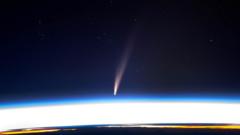
While visibility predictions are notoriously uncertain, Dr. Balaji encourages stargazers, especially in southern regions, to seek dark locations away from city lights and use binoculars or small telescopes for a better view. Astronomers are already tracking the comet’s journey, with images shared by NASA astronaut Don Pettit from the International Space Station. So, gather your friends and family, and prepare for this once-in-a-lifetime cosmic spectacle!
Spotted last year by NASA's Asteroid Terrestrial-impact Last Alert System, the comet is expected to be best seen from the southern hemisphere. According to Dr. Shyam Balaji from King's College London, current calculations indicate it will fly around 8.3 million miles away from the Sun, tagging it as a "sun-skirting" comet. "Look towards the eastern horizon before sunrise or the western horizon after sunset after perihelion," he advises.
While visibility predictions are notoriously uncertain, Dr. Balaji encourages stargazers, especially in southern regions, to seek dark locations away from city lights and use binoculars or small telescopes for a better view. Astronomers are already tracking the comet’s journey, with images shared by NASA astronaut Don Pettit from the International Space Station. So, gather your friends and family, and prepare for this once-in-a-lifetime cosmic spectacle!