In brief
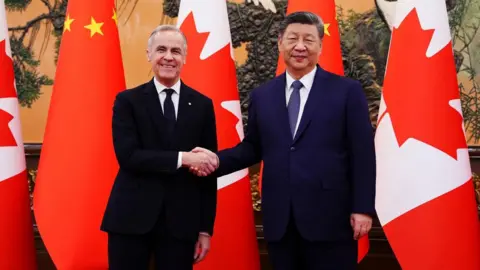
In a landmark meeting in Beijing, Canadian Prime Minister Mark Carney and Chinese President Xi Jinping announced plans to lower tariffs, signaling a redefined relationship between the two nations. Effective from March, tariffs on Canadian canola oil will drop from 85% to 15%, while Canada will implement a 6.1% tax on Chinese electric vehicles. This milestone focuses on diversifying trade and building a more stable partnership amidst changing global dynamics. Carney emphasized the need for continued discussions on sensitive topics, including human rights and trade agreements.
Chinese leader Xi Jinping and Canadian PM Mark Carney have announced lower tariffs, signalling a reset in their countries' relationship after a key meeting in Beijing. China is expected to lower levies on Canadian canola oil from 85% to 15% by 1 March, while Ottawa has agreed to tax Chinese electric vehicles at the most-favoured-nation rate, 6.1%, Carney told reporters. The deal is a breakthrough after years of strained ties and tit-for-tat levies. Xi hailed the 'turnaround' in their relationship but it is also a win for Carney, the first Canadian leader to visit China in nearly a decade. He has been trying to diversify Canadian trade away from the US, his country's biggest trading partner, following the uncertainty caused by Trump's on-again-off-again tariffs. The deal could also see more Chinese investments in Canada, right on America's doorstep. Carney himself seemed to allude to the fact that this was a result of Trump's tariffs, which have now pushed one of the US's key allies towards its biggest rival. He told reporters that Canada's relationship with China had been more 'predictable' in recent months and that he found talks with Beijing 'realistic and respectful'. He also made clear Ottawa does not agree with Beijing on everything, adding that in his discussions with Xi he made clear Canada's 'red lines', including human rights, concerns over election interference and the need for 'guardrails'. Observers believe Carney's visit could set an example for other countries across the world who are also feeling the pain from Washington's tariffs. In contrast, Xi has been trying to show that China is a stable global partner and has been urging more pragmatic ties - in the words of Beijing, 'a win-win' for all. And it seems to be working. The South Korean president and the Irish prime minister have both visited Beijing in recent weeks. The UK prime minister is expected to visit soon and so is the German Chancellor. Carney said the 'world has changed dramatically' and how Canada positions itself 'will shape our future for decades to come.' He added that the Canada-China partnership sets the two countries up for a 'new world order'. As the Chinese and Canadian delegations sat down in the Great Hall of the People on Friday, Xi said: 'The healthy and stable development of China-Canada relations is conducive to world peace, stability, development, and prosperity.' Tariffs have been a key sticking point between the two sides. In 2024, Canada imposed 100% tariffs on Chinese electric vehicles, following similar US curbs. Last year, Beijing retaliated with tariffs on over $2bn of Canadian farm and food products like canola seed and oil, resulting in a 10% drop in Chinese imports of Canadian goods in 2025. China is Canada’s second-largest trading partner, recording over C$118bn in two-way merchandise trade in 2024, significantly behind the US, which traded over $761bn worth of goods with Ottawa in the same year. Carney's visit is viewed as a 'reset of a relationship' that may be 'modest in ambition' but is 'realistic' about achievable outcomes. The last Canadian PM to visit China was Justin Trudeau in 2017, before relations soured following the arrest of Huawei's Meng Wanzhou. Despite the thawing relationship, Carney has emphasized that engagement with countries that possess different values must be managed with discipline.