In brief
European leaders are debating whether to allocate around €90bn of frozen Russian assets to Ukraine. With concerns from Belgium and Hungary, the decision could significantly impact Ukraine's funding as it struggles financially. The summit holds great importance for the future and potential peace talks in response to Russia's invasion.
European Union leaders begin two days of talks in Brussels with a momentous decision to be taken on whether to loan tens of billions of euros in frozen Russian assets to Ukraine to fund its military and economic needs.
Most of Russia's €210bn (£185bn; $245bn) worth of assets in the EU are held by Belgium-based organisation Euroclear, and so far Belgium and some other members of the bloc have said they are opposed to using the cash.
Without a boost in funding, Ukraine's finances are set to run dry in a matter of months.
One European government official described being cautiously optimistic, not overly optimistic that a deal would be agreed. Russia has warned the EU against using its money.
It has filed a lawsuit against Euroclear in a Moscow court in a bid to get its money back.
The Brussels summit comes at a pivotal moment.
US President Donald Trump has said a deal to end the war - which began with Russia's full-scale invasion of Ukraine in February 2022 - is closer now than we have been ever.
Although Russia has not responded to the latest peace proposals, the Kremlin has stressed that plans for a European-led multinational force for Ukraine supported by the US would not be acceptable.
President Vladimir Putin made his feelings towards Europe clear on Wednesday, when he said the continent was in a state of total degradation and European piglets - a derogatory description of Ukraine's European allies - were hoping to profit from Russia's collapse.
The European Commission - the EU's executive arm - has proposed loaning Kyiv about €90bn (£79bn) over the next two years - out of the €210bn of Russian assets sitting in Europe.
That is about two-thirds of the €137bn that Kyiv is thought to need to get through 2026 and 2027.
Until now the EU has handed Ukraine the interest generated by the cash but not the cash itself.
This is a crunch time for Ukraine to keep fighting for the next year, a Finnish government official told the BBC. There are of course peace negotiations but this gives Ukraine leverage to say 'we're not desperate and we have the funds to continue fighting'.
Commission chief Ursula von der Leyen says it will also ramp up the cost of war for Russia.
Russia's frozen assets are not the only option on the table for EU leaders. Another idea, backed by Belgium, is based on the EU borrowing the money on the international markets.
However, that would require a unanimous vote and Hungary's Viktor Orban has made it clear he will not allow any more EU money to help Ukraine.
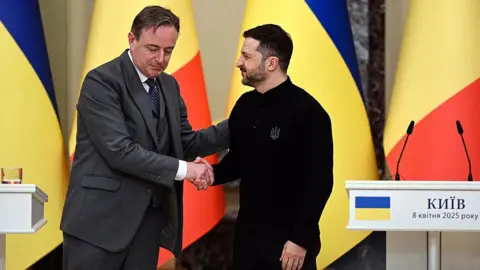
For Ukraine, the hours ahead are significant and President Volodymyr Zelensky is expected to attend the EU summit.
Ahead of the Brussels meeting, EU leaders were keen to stress the momentous nature of the decision.
German Chancellor Friedrich Merz has played a leading role in pushing for the Russian assets to be used, telling the Bundestag on the eve of the summit it was about sending a clear signal to Moscow that continuing the war was pointless.
EU officials are confident they have a sound legal basis to use the frozen Russian assets, but so far Belgian Prime Minister Bart De Wever remains unconvinced.
Some countries have said they would be prepared to provide billions of euros in financial guarantees, but Belgium will want to see the numbers add up.