In brief
In a surprising discovery, mosquitoes have been found in Iceland for the first time, following an extraordinary heat wave. Entomologist Bjorn Hjaltason encountered three mosquitoes in Kjós, leading to confirmation of their species. This finding has raised concerns about the impact of climate change on Iceland's previously mosquito-free environment, largely due to its cold climate and lack of stagnant water. As the country faces rising temperatures, experts express the need for continued monitoring of this new addition to Iceland's ecosystem.
Mosquitoes have been found in Iceland for the first time after the country experienced record-breaking heat this spring.
Insect enthusiast Bjorn Hjaltason encountered the mosquitoes over several nights last week while using wine-soaked ropes to observe moths, local media reported.
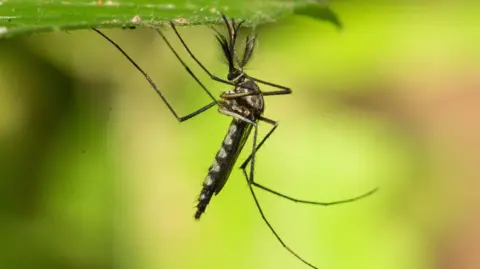
Mr Hjaltason found two female mosquitoes and one male which were later confirmed to be Culiseta annulata, one of few species that can successfully survive winter.
Iceland was one of only two mosquito-free havens in the world prior to the discovery, partly due to its cold climate. The only other recorded mosquito-free zone is Antarctica.
The mosquitoes were found in Kjós, a glacial valley to the South West of the Icelandic capital of Reykjavik.
Mr Hjaltason shared the news of his discovery on a Facebook page for local wildlife alongside pictures of the insects, describing 'a strange fly on a red wine ribbon'.
I could tell right away that this was something I had never seen before, he said in the post, adding 'the last fortress seems to have fallen.'
Mr Hjaltason sent the insects to the Icelandic Institute of Natural History to be identified, where entomologist Matthías Alfreðsson confirmed his suspicions.
The species are common across parts of Europe and North Africa but it isn’t clear how they reached Iceland, Alfreðsson told CNN.
Iceland's cold climate and lack of stagnant water in which the insects can breed are key contributors to the country's former lack of mosquitoes, according to the World Population Review.
However, this year, the country broke multiple records for its high temperatures, typically rarely exceeding 20C (68F) in May. This threshold was exceeded for 10 consecutive days.
Iceland also saw its hottest ever day in May, with temperatures rising to 26.6C (79.8F) at Eglisstaðir Airport.
A June study published by the Global Heat Health Information Network noted that such shifts might have 'significant' impacts on delicate ecosystems adapted to the cold climate.
Last year was recorded as the hottest on record globally, and the UN's climate body confirmed that human influence has 'unequivocally' warmed the atmosphere.
Further monitoring will be required in spring to see if the mosquito species has 'truly become established in Iceland', Alfreðsson noted.
Hjaltason speculated on the origin of the specimens, suggesting that they might have arrived via ships or containers, hinting at a possible larger influx.