In brief
K-beauty, once a viral trend, has become a dominant force in the beauty industry, with the South Korean market valued at $13 billion. The rise of K-beauty is fueled by innovative products and a strong social media presence, leading to a competitive global market. As South Korea surpasses France in beauty exports, the industry faces challenges from rising ideals of beauty and competition. With brands adapting quickly and incorporating natural ingredients, K-beauty continues to evolve amidst changing consumer preferences.
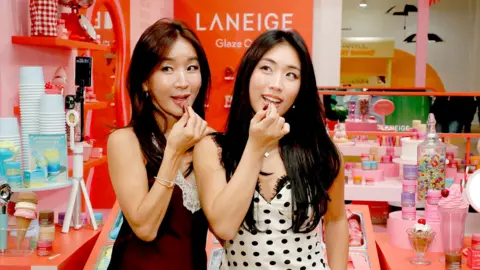
Who would have thought serums infused with snail mucin - the sticky substance they secrete - would become a part of skincare routines around the world? Well, it's happened - and the gooey elasticity is key, according to a viral TikTok challenge promoting the serum. It made its manufacturer, the small South Korean label CosRX, go global. It is now owned by Amorepacific, the country's biggest cosmetics company.The rapid spread of that sticky serum tells you just how wildly successful K-beauty has become. Fuelled by viral content and trends, it is one of the biggest industries in South Korea, where the pressure to look almost flawless has always been huge in a highly competitive society. The domestic market alone was valued at about $13bn (£9.6bn) in 2024, with sales of some products expected to grow at double-digit rates. The rest of the world is just as obsessed with K-beauty - which is perhaps unsurprising given it's part of the Hallyu, or Korean Wave, which has made K-Pop and K-dramas a global phenomenon.K-beauty brands now occupy whole sections at global retailers - from Sephora to Boots to Walmart. In the first half of 2025, South Korea overtook France, the birthplace of modern cosmetics, to become the world's second-largest exporter of beauty products, after the United States.Search for 'Korean skincare' on TikTok, Instagram or YouTube and you'll be met with a deluge of content from influencers, some of whom have hundreds of millions of followers. They dissect ingredient lists, film unboxings and record 'Get Ready With Me' videos built around ideas such as 'glass skin', sheet masks and, of course, snail mucin. 'There are so many products and brands, and a lot of times you're exposed to millions of them as a consumer - it's highly saturated and competitive,' said Liah Yoo, a beauty influencer and founder of the US-based K-beauty brand Krave Beauty.At the heart of K-beauty's rise is a relentless pace of innovation. New formulations appear every few months, often designed to spark the next online obsession. Ten-step skincare routines, overnight 'water sleeping masks' and headline-grabbing ingredients such as salmon sperm were once viewed as niche or unappealing. Today, many are staples in bathroom cabinets from London to Los Angeles.Social media has been central to this shift. Products launched in Seoul are on TikTok and Instagram feeds in the US, UK, India and Australia instantly. There are however growing concerns about the social impact of beauty ideals, particularly on young people. Experts warn that constant exposure to skincare content online can fuel anxiety and excessive spending.In 2024, Amorepacific sold about $6.2bn of products. LG Household & Health Care, another major conglomerate, recorded sales of $4.1bn. The scale of the industry continues to show up in South Korea's export figures too. Exports rose 15% in the first half of 2025 to a record $5.5bn, largely driven by strong sales in the US and Europe, putting the country on track to surpass $10bn in annual beauty exports.