In brief
Air India flight AI171 crashed shortly after takeoff from Ahmedabad, killing 260 people. Safety advocates claim that the aircraft suffered various technical issues, including an in-flight fire, leading to growing scrutiny over Boeing's safety culture. A US-based aviation safety group has presented findings to Congress, while the ongoing investigation by India's AAIB reveals alarming details about the aircraft's technical problems since it entered service.
Aviation safety campaigners in the United States say they have evidence a plane that crashed in India last year had previously suffered a series of technical failures, including an in-flight fire.
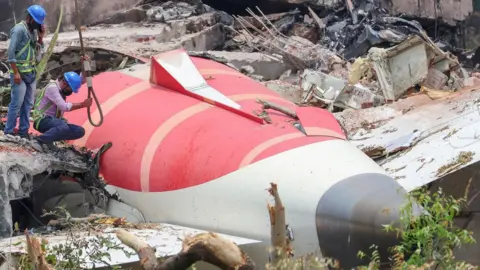
The Boeing 787 Dreamliner crashed on 12 June, shortly after taking off from Ahmedabad en route to London, killing 260 people.
The Foundation for Aviation Safety, a US campaign group, has sent a presentation to the US Senate outlining its findings, which it says are based on documents that have come into its possession.
The official investigation into the accident is ongoing. However, an interim report published in July sparked widespread speculation and controversy. Boeing declined to comment.
The aircraft involved in the accident, registered as VT-ANB, was one of the earliest 787s to be built. It first flew in late 2013, and entered service with Air India in early 2014.
The Foundation for Aviation Safety says documents show that the plane experienced system failures from its very first day in service for Air India. It alleges these were caused by a wide and confusing variety of engineering, manufacturing, quality, and maintenance problems.
The failures included electronics and software faults, circuit breakers tripping repeatedly, damage to wiring, short circuits, loss of electrical current, and overheating of power system components.
In January 2022, it says, there was a fire in the P100 power distribution panel. This is one of five such panels that take high-voltage power generated by the engines and distribute it around the aircraft.
The pilots started receiving fault messages during a descent into Frankfurt Airport - and the damage was discovered afterwards. It was so severe, the FAS says, that the entire panel had to be replaced.
The 787 relies more heavily on electrical systems than previous generations of passenger aircraft. In an attempt to improve efficiency, its designers got rid of numerous mechanical and pneumatic components, and replaced them with electrical ones, which were lighter.
However, this led to problems early in the aircraft's existence, including a major battery fire on a plane owned by Japan Airlines in 2013, which led to a temporary grounding of the 787 fleet.
The Foundation's report has been sent to the US Senate Permanent Subcommittee on Investigations, which last year held hearings into Boeing's broken safety culture. The AAIB's investigation is supported by American officials since the aircraft and engines were designed and built in the US.
A month after the accident, the AAIB published a preliminary report summarizing known facts at the time of publication without drawing firm conclusions.
The report indicated that moments after take-off, the plane's fuel control switches were moved to the cut-off position, causing engines to lose thrust rapidly.
This has spurred debate on whether the incident was pilot error or a technical malfunction. Critics argue that blaming pilots diverts attention from potential aircraft issues.
Boeing has stated that the 787 is a safe aircraft, and prior to the Ahmedabad crash, it had operated without fatality for over a decade.
The Foundation's findings have raised alarms about the 787 model's wider safety record, pointing to numerous reports of maintenance failures in various regions.