In brief
At Sciences Po Saint-Germain in Paris, a special diploma course in intelligence training attracts both typical university students and active members of the French intelligence community. Developed in collaboration with the Academie du Renseignement, the course aims to equip participants with essential skills to understand and tackle global threats. With a mix of classroom learning and specialized modules, it’s become a popular program for those wanting to delve into the intricacies of intelligence work amidst rising cybersecurity challenges and global tensions.
University professor Xavier Crettiez admits that he doesn't know the real names of many of the students on his course.
This is a highly unusual state of affairs in the world of academia, but Prof Crettiez's work is far from standard.
Instead, he helps train France's spies.
I rarely know the intelligence agents' backgrounds when they are sent on the course, and I doubt the names I'm given are genuine anyway, he says.
If you wanted to create a setting for a spy school, then the campus of Sciences Po Saint-Germain on the outskirts of Paris seems a good fit.
With dour, even gloomy-looking, early 20th Century buildings surrounded by busy, drab roads and large, intimidating metal gates, it has a very discreet feel.
Where it does stand out is its unique diploma that brings together more typical students in their early 20s, and active members of the French secret services, usually between the ages of 35 and 50.
The course is called Diplôme sur le Renseignement et les Menaces Globales, which translates as Diploma of Intelligence and Global Threats.
It was developed by the university in association with the Academie du Renseignement, the training arm of the French secret services.
This came following a request from French authorities a decade ago. After the 2015 terrorist attacks in Paris, the government went on a large recruitment drive within the French intelligence agencies.
It asked Sciences Po, one of France's leading universities, to come up with a new course to both train potential new spies, and provide continuous training for current agents.
Large French companies were also quick to show an interest, both in getting their security staff onto the course, and snapping up many of the younger graduates.
The diploma is made up of 120 hours of classwork with modules spread over four months. For external students – the spies and those on placement from businesses – it costs around €5,000 ($5,900; £4,400).
The core aim of the course is to identify threats wherever they are, and how to track and overcome them. The key topics include the economics of organized crime, Islamic jihadism, business intelligence gathering and political violence.
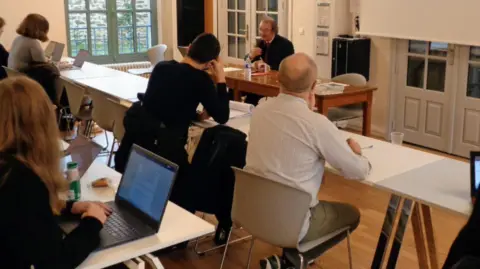
To attend one of the classes and speak to the students I had to be vetted first by the French security services. The theme of the lesson I joined was intelligence and over-reliance on technology.
Prof Crettiez, who teaches political radicalisation, says there has been a huge expansion in the French secret services in recent years. There are now around 20,000 agents in what he called the inner circle.
This includes the DGSE, which looks at matters overseas, and is the French equivalent of the UK's MI6 or the US's CIA, and the DGSI, which focuses on threats within France.
Prof Crettiez notes, there are the two main security agencies, but also Tracfin, an intelligence agency specialising in money laundering, preoccupied with the surge in mafia activity, especially in southern France.
The private sector's interest in the diploma is also growing. Companies in the defence, aerospace, and luxury goods are increasingly keen to hire these students.
Twenty-eight students are enrolled in this year's class, with six being spies. You can spot them huddled in groups during breaks, appearing reticent when approached.
One young student, Alexandre Hubert, aims to understand the economic tensions with China, explaining that the job now involves assessing risk rather than glamorous spy fantasies.
Nearly half of the students are women, a notable change reflected in their patriotic enthusiasm for making the world better.
For aspiring spies, French citizenship is essential for course applications, but some dual citizens may be considered.