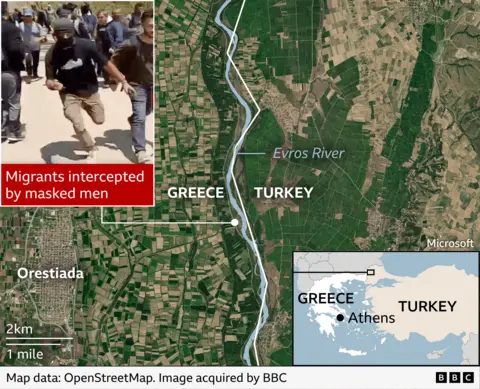
Police in Greece have been accused of actively recruiting migrants to violently push other migrants back across its land border with Turkey, according to a revealing investigation by the BBC that uncovers widespread evidence of human rights violations. Internal police documents suggest that senior officers ordered the recruitment of so-called mercenaries, while witnesses report severe brutality including physical assaults and theft.
Pushbacks, the practice of forcibly returning migrants and asylum seekers without due process, are widely regarded as illegal under international law. The Greek prime minister, in a statement to the BBC, claimed to be 'totally unaware' of these allegations, while the authorities have not responded to requests for comment.
Our investigation began after disturbing videos alleging mistreatment by mercenaries emerged last autumn, revealing systematic violence reported by migrants and former police officers. Accounts include instances where migrants were beaten, stripped of their belongings, and in some cases, assaulted.
The evidence suggests that private mercenaries—many of whom are also migrants from countries like Pakistan and Afghanistan—are being employed to facilitate these pushbacks in exchange for cash and a means of passage within Greece.
A police source claims these mercenaries could push back as many as hundreds of people each week. Despite the Greek authorities' insistence of a stringent border control policy, the reality suggests a troubling trend of human rights abuses occurring behind the scenes.
The situation reflects the broader issues within the EU regarding the treatment of migrants and their rights, particularly at such a pivotal border area between Turkey and Greece. The disturbing reports of asylum seekers being mistreated have raised serious questions about the ethical implications of border management tactics employed across Europe.}
Pushbacks, the practice of forcibly returning migrants and asylum seekers without due process, are widely regarded as illegal under international law. The Greek prime minister, in a statement to the BBC, claimed to be 'totally unaware' of these allegations, while the authorities have not responded to requests for comment.
Our investigation began after disturbing videos alleging mistreatment by mercenaries emerged last autumn, revealing systematic violence reported by migrants and former police officers. Accounts include instances where migrants were beaten, stripped of their belongings, and in some cases, assaulted.
The evidence suggests that private mercenaries—many of whom are also migrants from countries like Pakistan and Afghanistan—are being employed to facilitate these pushbacks in exchange for cash and a means of passage within Greece.
A police source claims these mercenaries could push back as many as hundreds of people each week. Despite the Greek authorities' insistence of a stringent border control policy, the reality suggests a troubling trend of human rights abuses occurring behind the scenes.
The situation reflects the broader issues within the EU regarding the treatment of migrants and their rights, particularly at such a pivotal border area between Turkey and Greece. The disturbing reports of asylum seekers being mistreated have raised serious questions about the ethical implications of border management tactics employed across Europe.}