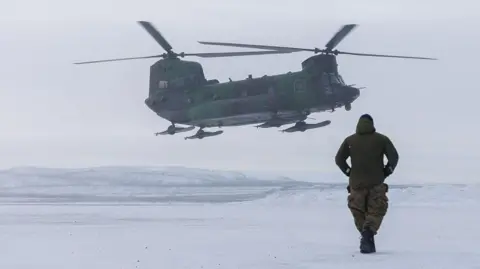
Canada's Arctic is a massive, treacherous, and largely inhospitable place, encompassing nearly 4 million square kilometers. Yet, it has a small population comparable to Blackburn in England or Syracuse, New York. Pierre Leblanc, a former commander of the Canadian Forces Northern Area, describes the Arctic environment as extremely dangerous.
Currently, Canada's defense strategy relies on aging early warning radars, eight military bases, and about 100 Coast Guard personnel covering an extensive coastline. The Arctic region is also the focus of intense geopolitical competition among Russia, the US, and increasingly, China, which has declared itself a 'near Arctic state.'
In the wake of heightened security issues, particularly following Russia's invasion of Ukraine, Prime Minister Mark Carney reassured allies of Canada's commitment to the Arctic by pledging 'unprecedented' investments in radar systems and other military assets. These efforts are crucial as the Canadian government seeks to bolster its defense amidst concerns over US adversaries.
Significant challenges remain, including outdated defense infrastructure and logistical difficulties in resupplying remote bases. Experts express concern over evolving threats, particularly hypersonic missiles used by Russia, which require a complete overhaul of North America's defense systems to counter effectively.
While Canada works towards enhancing its Arctic capabilities, it faces pressures from the US regarding security responsibilities. Both nations strive to collaborate on Arctic defense, despite political complexities influencing their relationship.
Overall, Canada recognizes the urgent need for enhanced Arctic defense and is committed to adapting to new challenges while reinforcing its sovereignty in the region.