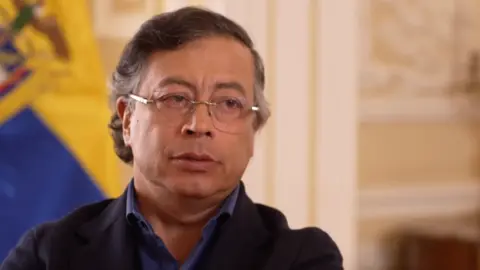
Colombia's President Gustavo Petro has told the BBC that he believes there is now a 'real threat' of US military action against Colombia. Petro said the United States is treating other nations as part of a US 'empire'. It comes after Trump threatened Colombia with military action. He said that the US risks transforming from 'dominating the world' to becoming 'isolated from the world.' He also accused US Immigration and Customs Enforcement (ICE) agents of acting like 'Nazi brigades'. Trump has significantly expanded ICE operations as part of what the administration says is a crackdown on crime and immigrants who illegally entered the US.
Following US strikes on Venezuela, President Donald Trump remarked that targeting Colombia 'sounds good.' He has also warned Petro to 'watch his ass,' remarks Petro has condemned. In a recent phone call, the two discussed issues including drug trafficking and political relations, but the tone from Petro indicates ongoing tension rather than reconciliation.
Petro critiqued US immigration enforcement, linking it to violence and claiming it has resulted in the death of US citizens. He highlighted ICE’s actions as an affront to Latin Americans.
As Trump's administration continues its aggressive policy stance, Petro framed the current geopolitical climate as a potential shift toward isolationism for the US, criticizing its historic treatment of Latin America like an 'empire.'
In light of a complex and strained relationship, Petro emphasized the need for dialogue over military confrontation, reflecting on Colombia's historical struggles against foreign military influence. Both leaders' remarks and actions underscore the fragile and contentious nature of US-Colombia relations amid pressing issues like drug trafficking and immigration.
Following US strikes on Venezuela, President Donald Trump remarked that targeting Colombia 'sounds good.' He has also warned Petro to 'watch his ass,' remarks Petro has condemned. In a recent phone call, the two discussed issues including drug trafficking and political relations, but the tone from Petro indicates ongoing tension rather than reconciliation.
Petro critiqued US immigration enforcement, linking it to violence and claiming it has resulted in the death of US citizens. He highlighted ICE’s actions as an affront to Latin Americans.
As Trump's administration continues its aggressive policy stance, Petro framed the current geopolitical climate as a potential shift toward isolationism for the US, criticizing its historic treatment of Latin America like an 'empire.'
In light of a complex and strained relationship, Petro emphasized the need for dialogue over military confrontation, reflecting on Colombia's historical struggles against foreign military influence. Both leaders' remarks and actions underscore the fragile and contentious nature of US-Colombia relations amid pressing issues like drug trafficking and immigration.