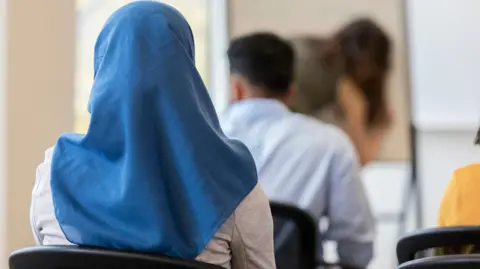
Austria has passed a law banning headscarves in schools for girls under the age of 14. The conservative-led coalition of three centrist parties, the ÖVP, the SPÖ and the Neos, claims the law is a clear commitment to gender equality, yet critics argue it might incite anti-Muslim sentiments and could be unconstitutional. The measure will apply to girls in both public and private schools. A similar ban aimed at girls under 10 was annulled by the Constitutional Court in 2020 for specifically targeting Muslims.
Under the new law, girls under 14 will be prohibited from wearing traditional Muslim head coverings, including hijabs and burkas. Should a student breach this ban, they will enter discussions with school authorities and their guardians. Repeated violations could lead to notification of child welfare services and potential fines up to €800 (£700) for families.
Government officials assert this legislation empowers young girls and is designed to protect them from oppression. Yannick Shetty, parliamentary leader of the liberal Neos party, emphasized that it is not anti-religion but aims to safeguard girls' freedoms, impacting about 12,000 children.
The far-right Freedom Party (FPÖ), supporting the ban, demands it expand to encompass all students and staff, claiming political Islam should not be present in schools. Contrarily, opposition figures, including Sigrid Maurer from the Greens, deem the law clearly unconstitutional. The Islamic Community in Austria (IGGÖ) criticized the ban for breaching fundamental rights, expressing concern about marginalizing affected children.
An awareness-raising trial will kick off in February 2026, with the full ban going into effect by the next school year.
Under the new law, girls under 14 will be prohibited from wearing traditional Muslim head coverings, including hijabs and burkas. Should a student breach this ban, they will enter discussions with school authorities and their guardians. Repeated violations could lead to notification of child welfare services and potential fines up to €800 (£700) for families.
Government officials assert this legislation empowers young girls and is designed to protect them from oppression. Yannick Shetty, parliamentary leader of the liberal Neos party, emphasized that it is not anti-religion but aims to safeguard girls' freedoms, impacting about 12,000 children.
The far-right Freedom Party (FPÖ), supporting the ban, demands it expand to encompass all students and staff, claiming political Islam should not be present in schools. Contrarily, opposition figures, including Sigrid Maurer from the Greens, deem the law clearly unconstitutional. The Islamic Community in Austria (IGGÖ) criticized the ban for breaching fundamental rights, expressing concern about marginalizing affected children.
An awareness-raising trial will kick off in February 2026, with the full ban going into effect by the next school year.