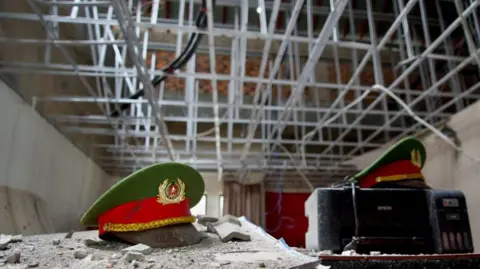
Wandering down the unlit corridors of a six-storey building behind the Royal Hill casino, each door opens onto a different world. In one there is a perfect replica of a Vietnamese bank. In another, you're in an Australian police station. A Chinese police officer's shirt hangs in one corner.
Motivational messages have been painted on the walls. Money Coming From Everywhere, read the Chinese characters on one sign. Discarded fake hundred dollar bills are lying all over the floor.
This was a massive scam compound, just inside Cambodia in a border town called O Smach. Thousands of people from different countries worked here, under a harsh regime which strictly regimented their lives, defrauding thousands of others across the world of their savings.
In December, Royal Hill was bombed by the Thai air force during the brief border war between the two countries. The workers fled, leaving behind uneaten bowls of noodles and half-drunk cans of coke.
Today, Royal Hill is empty, aside from the Thai soldiers occupying it. The windows have been shattered by the bombardment, and debris coats everything in dust.
The Thai military claims they wanted to expose the large scam industry's presence in Cambodia, emphasizing the need for international help to shut it down. Cambodia's government protested the Thai military's presence, but the situation has raised significant concerns on both sides.
Royal Hill and its exploitative operations were largely overlooked until now, with allegations surrounding major tycoons like Ly Yong Phat, known for their wealth tied to land grabs and illicit industries. Recent developments feature raids on scam compounds and promises from government officials to completely eradicate these operations by the end of April.
Yet skepticism remains; many believe it's just a matter of relocating fraudulent operations to lower-profile compounds instead of eradicating them entirely, with many high-profile figures still operating with impunity.
Motivational messages have been painted on the walls. Money Coming From Everywhere, read the Chinese characters on one sign. Discarded fake hundred dollar bills are lying all over the floor.
This was a massive scam compound, just inside Cambodia in a border town called O Smach. Thousands of people from different countries worked here, under a harsh regime which strictly regimented their lives, defrauding thousands of others across the world of their savings.
In December, Royal Hill was bombed by the Thai air force during the brief border war between the two countries. The workers fled, leaving behind uneaten bowls of noodles and half-drunk cans of coke.
Today, Royal Hill is empty, aside from the Thai soldiers occupying it. The windows have been shattered by the bombardment, and debris coats everything in dust.
The Thai military claims they wanted to expose the large scam industry's presence in Cambodia, emphasizing the need for international help to shut it down. Cambodia's government protested the Thai military's presence, but the situation has raised significant concerns on both sides.
Royal Hill and its exploitative operations were largely overlooked until now, with allegations surrounding major tycoons like Ly Yong Phat, known for their wealth tied to land grabs and illicit industries. Recent developments feature raids on scam compounds and promises from government officials to completely eradicate these operations by the end of April.
Yet skepticism remains; many believe it's just a matter of relocating fraudulent operations to lower-profile compounds instead of eradicating them entirely, with many high-profile figures still operating with impunity.