In brief
Unitree's G1 and Tesla's Optimus highlight a growing trend in AI-driven humanoid technology.
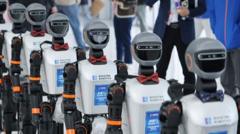
Unitree, a Chinese company, has introduced the G1 robot at the Hannover Messe, showcasing how it stands at just 4'3" tall and boasts remarkable fluid movement. In a world where humanoid robots are becoming increasingly popular, the G1 has captured attention through viral dance and martial arts videos. Despite its potential, the technology is still developing; effective AI is needed for robots to operate autonomously, especially in unpredictable environments like homes and restaurants.Tesla is also in the race with its humanoid robot, Optimus, with plans to deploy thousands this year. Other companies like BMW and Hyundai are catching up, emphasizing the competitive landscape. Reports indicate that China is poised to dominate the humanoid market, accounting for nearly 60% of global funding. American and European firms face challenges due to their dependence on Chinese-manufactured components, making competition difficult. Ventures such as Kinisi, founded by Bren Pierce in the UK, are redirecting strategy by simplifying designs and focusing on easier-to-use robots that can be quickly trained by workers.The ambition for humanoid robots reaching the consumer market is a distant dream, projected to be around 10 to 15 years away, leaving many innovative solutions still in the lab. As humanoid robots evolve, the question remains: who will emerge victorious in this high-stakes race?