In brief
In the heart of Tehran, ordinary citizens grapple with the dual challenges of rampant inflation and the anxiety of war on the horizon. Businesses are feeling the strain, with many losing customers and jobs amid ongoing political instability. Residents express a mix of hope and skepticism as they endure rising costs and a government shutdown of internet access that limits their daily lives. A vivid portrayal of life in Tehran is illustrated through personal stories, revealing a city alive with resilience, but overshadowed by economic crises and the specter of conflict.
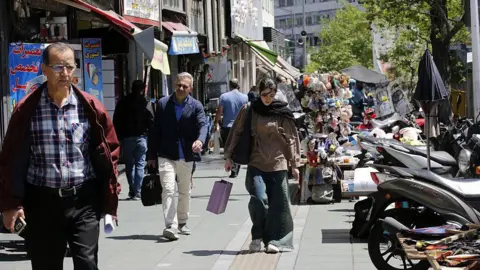
On a bright Tehran spring day, Sanaei Ghaznavi street, with its mix of shops selling groceries and household goods alongside fast food and flowers, seems like an everyday place. In a country where lives have long been buffeted by crises, it is a snapshot of a people just trying to get through the day while their future hangs on forces beyond their control. For Mohammad, in t-shirt and jeans, even cranking open the striped awning of his family's shoe shop is an act of hope. 'It makes me happy to be in here,' he tells us when we wander into his pocket of a store with its floor-to-ceiling shelves of trainers, big and small. 'So many people have lost their jobs and aren't working.' And there are few customers. 'We had so many before,' his father Mustafa laments glumly as he proudly explains this business has been in their family for 40 years. One Iranian website, Asr-e Iran, recently cited an unofficial estimate that up to four million jobs may have been lost or impacted by the combined effect of the war and the government's near-total internet shutdown. Boxes labelled with western logos like New Balance and Clarks protrude from this shop's packed shelves. 'Made in China,' both father and son note matter-of-factly. 'Even fakes are expensive in Iran,' Mohammad adds. I expect them to express hope that the shaky ceasefire will hold, and that negotiations with America will succeed, in order to allow them to import the real deal when it comes to the latest fashions in footwear. 'We hope the war starts again,' Mohammad declares, breaking into a wry smile. His father eyes knowingly his 27-year-old son. 'Look at my grey hair, I understand more than him.' 'We're just tired of living with an economy which keeps getting worse,' Mustafa says. 'Some people believe that, if war returns, things will eventually improve dramatically.' Outside the nearby corner shop, Shahla, an elderly woman wearing a pale headscarf balances a loaf of bread on a clipboard securing her shopping list and a wadge of bills. 'People are paying three times more for a loaf of bread now,' she moans, her fingers resting on the soft white slices inside the plastic. 'People are going through hell now just to pay for bread.' Restrictions are slowly and selectively easing – although the message from security officials is they will stay in force as long as 'enemy threats' remain. Many women, young and old, no longer comply with laws dictating that they dress 'modestly' and cover their heads, a legacy of the 'Women, Life, Freedom' protests which swept Iran a few years ago. As the sun sinks, we drive to one of many nearby squares where government supporters have been gathering nightly in response to their new leaders' call to show defiance and solidarity. Tonight, rows of chairs stretching across this space are filled for an open-air debate on issues such as whether their late leader had approved negotiations with America. In Vali-e Asr Square, there is a thicket of Iranian flags set against the backdrop of a new towering mural of the former supreme leader Ayatollah Ali Khamenei, assassinated by Israeli airstrikes in the very first hours of the war on 28 February. As we leave the square, there is a sudden roar.