In brief
China's economy is encountering significant challenges as it deals with the effects of the US-Iran war and previous tariffs imposed by Donald Trump. Workers in manufacturing hubs report low wages and fewer job opportunities, while traders in cities like Guangzhou struggle with rising costs of production. Despite these pressures, China's push into electric vehicles shows potential as exporters seek new markets outside the Middle East.
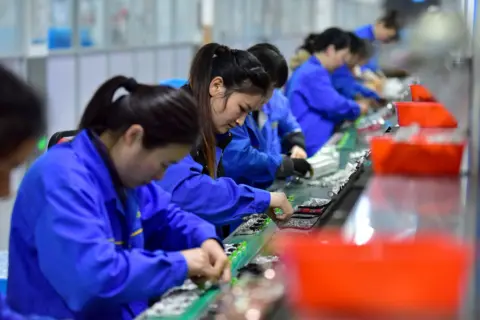
It's a sombre gathering in the backstreets of one of China's biggest manufacturing hubs, where workers are smoking under a tree in front of storefronts advertising temporary factory jobs. No-one understands what our life is like, says one man who is unwilling to be named. We work and work and have no life. Please help us, another adds - a rare, risky plea to a foreign journalist. They seem desperate, struggling to earn enough to send money home, as they cope with the massive shifts in Chinese manufacturing, from cheap, mass-produced goods to automated advanced tech. This was even before the US-Israel war with Iran shook the global economy.China's economy was already battling slower growth and unemployment when Donald Trump's tariffs hit last year. Still, it proved resilient, boosting exports and reporting GDP growth of around 5%. But the discontent continued to simmer, and now the Middle East conflict is starting to take a fresh toll, putting pressure on factory orders, costs, and jobs. In Foshan, in the southern industrial province of Guangdong, the workers' best opportunities are plastered in bright red lettering in front of them: a few weeks of moulding plastic, or screwing together parts of a mobile phone, for 18 to 20 yuan an hour, which amounts to just a few dollars or pounds.I'm going to try and find work elsewhere, says another worker from a rural province, frustrated at yet more uncertainty. This is one of the reasons Beijing is calling for the war to end. China's enviable oil reserves and the lead it has taken in renewables and electric cars have insulated it from the worst effects of the fuel crisis. But even as it puts on a show of steady strength, the war is choking the Strait of Hormuz, a crucial shipping route, causing more pain to a sluggish Chinese economy heavily relying on exports.Costs have gone up around 20%, says a trader who didn't want to be named. This is the world's largest fabric market – in Guangzhou, and the streets pulse with motorbikes laden with rolls of vibrant textiles. Their trade needs a cheap and steady supply of oil, without which they cannot produce fabric. Higher oil prices are now hitting them hard. It means fewer orders, one trader reveals over tea. Despite low wages and high living costs, there is still opportunity amidst the uncertainty, especially visible at the Canton Fair where manufacturers are showcasing innovative goods. Chinese manufacturers exported 350,000 EVs in March alone, a 30% increase from February, showcasing China's strength in this sector even as other areas struggle. In essence, while China navigates a complex global landscape and calls for an end to the Iran conflict to stabilize economic conditions, it continues to adapt and search for new markets and opportunities.