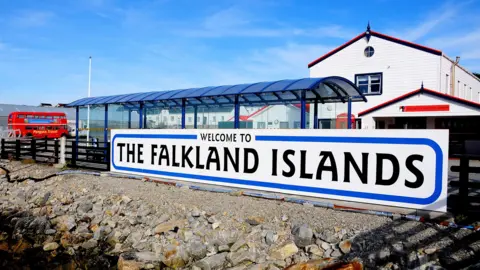
Sovereignty of the Falkland Islands rests with the UK, Downing Street has said, following a report the US could review its position on Britain's claim to the territory. An internal Pentagon email reported by Reuters suggested the US was considering options to punish NATO allies it believed had failed to support its war on Iran. The options discussed also included seeking Spain's suspension from NATO over its opposition to the war. BBC News has not been able to review the email.
A Pentagon spokesperson did not comment on the email's existence, but said it would ensure that the president has credible options to ensure that our allies are no longer a paper tiger and instead do their part.
As President [Donald] Trump has said, despite everything that the United States has done for our NATO allies, they were not there for us, the spokesperson added.
The Falkland Islands, a British overseas territory in the south-west Atlantic Ocean, remain the subject of a sovereignty dispute between Britain and Argentina. Asked about the report, a No 10 spokesman on Friday said: The Falkland Islands have previously voted overwhelmingly in favour of remaining a UK overseas territory, and we've always stood behind the islanders' right to self-determination and the fact that sovereignty rests with the UK.
The prime minister's official spokesman also said the government could not be clearer about the UK's position, and that sovereignty rests with the UK and the islanders' right to self-determination is paramount.
He continued: We've expressed this position previously clearly and consistently to successive US administrations and nothing is going to change that. Former Labour security minister Lord West BBC Radio 4's The World Tonight programme the Pentagon leak on the Falklands was quite extraordinary and showed a lack of understanding.
Lord West, who was an officer commanding HMS Ardent during the Falklands War, went on to describe US Defence Secretary Pete Hegseth as thick and accused him of having a total lack of understanding about NATO.
Under NATO's Article 5, an armed attack against one or more members is considered an attack against all, and in response, each other member would take such action as it deems necessary, including the use of armed force, to restore and maintain the security of the North Atlantic area. The only time Article 5 has been invoked was after the 9/11 attacks on the US in 2001.
Previous US administrations have formally recognised the UK's de facto administration of the islands, but have not taken a formal position regarding sovereignty. The Falkland Islands have complete confidence in the commitment made by the UK government to uphold and defend our right of self-determination, the islands' government said in a statement.
Argentina's foreign minister Pablo Quirno wrote on X on Friday that his country rejected this, stating that those living in the Falkland Islands had never been recognised as a people by the UN.
Argentina reaffirms its sovereign rights over the Malvinas Islands, Quirno wrote, adding: The Argentine Republic once again expresses its willingness to resume bilateral negotiations with the United Kingdom that will allow for finding a peaceful and definitive solution to the sovereignty dispute.
The Falkland Islands have been under British rule since 1833, but Argentina has historically said it has a right to them on the basis it inherited them from the Spanish crown, as well as the islands' proximity to the South American mainland. In 1982, a 10-week conflict between the UK and Argentina over the islands was triggered when the latter's military dictator, Leopoldo Galtieri, ordered his country's forces to invade them. The then UK Prime Minister Margaret Thatcher's government sent a naval task force to recapture the islands, resulting in the surrender of Argentine forces.
More recently, Falkland Islanders have overwhelmingly expressed their desire to remain as a British territory, with a 2013 referendum seeing over 90% voting in favor. Successive British governments have maintained that the island's population has a right to self-determination under international law established by the United Nations Charter.
A Pentagon spokesperson did not comment on the email's existence, but said it would ensure that the president has credible options to ensure that our allies are no longer a paper tiger and instead do their part.
As President [Donald] Trump has said, despite everything that the United States has done for our NATO allies, they were not there for us, the spokesperson added.
The Falkland Islands, a British overseas territory in the south-west Atlantic Ocean, remain the subject of a sovereignty dispute between Britain and Argentina. Asked about the report, a No 10 spokesman on Friday said: The Falkland Islands have previously voted overwhelmingly in favour of remaining a UK overseas territory, and we've always stood behind the islanders' right to self-determination and the fact that sovereignty rests with the UK.
The prime minister's official spokesman also said the government could not be clearer about the UK's position, and that sovereignty rests with the UK and the islanders' right to self-determination is paramount.
He continued: We've expressed this position previously clearly and consistently to successive US administrations and nothing is going to change that. Former Labour security minister Lord West BBC Radio 4's The World Tonight programme the Pentagon leak on the Falklands was quite extraordinary and showed a lack of understanding.
Lord West, who was an officer commanding HMS Ardent during the Falklands War, went on to describe US Defence Secretary Pete Hegseth as thick and accused him of having a total lack of understanding about NATO.
Under NATO's Article 5, an armed attack against one or more members is considered an attack against all, and in response, each other member would take such action as it deems necessary, including the use of armed force, to restore and maintain the security of the North Atlantic area. The only time Article 5 has been invoked was after the 9/11 attacks on the US in 2001.
Previous US administrations have formally recognised the UK's de facto administration of the islands, but have not taken a formal position regarding sovereignty. The Falkland Islands have complete confidence in the commitment made by the UK government to uphold and defend our right of self-determination, the islands' government said in a statement.
Argentina's foreign minister Pablo Quirno wrote on X on Friday that his country rejected this, stating that those living in the Falkland Islands had never been recognised as a people by the UN.
Argentina reaffirms its sovereign rights over the Malvinas Islands, Quirno wrote, adding: The Argentine Republic once again expresses its willingness to resume bilateral negotiations with the United Kingdom that will allow for finding a peaceful and definitive solution to the sovereignty dispute.
The Falkland Islands have been under British rule since 1833, but Argentina has historically said it has a right to them on the basis it inherited them from the Spanish crown, as well as the islands' proximity to the South American mainland. In 1982, a 10-week conflict between the UK and Argentina over the islands was triggered when the latter's military dictator, Leopoldo Galtieri, ordered his country's forces to invade them. The then UK Prime Minister Margaret Thatcher's government sent a naval task force to recapture the islands, resulting in the surrender of Argentine forces.
More recently, Falkland Islanders have overwhelmingly expressed their desire to remain as a British territory, with a 2013 referendum seeing over 90% voting in favor. Successive British governments have maintained that the island's population has a right to self-determination under international law established by the United Nations Charter.