In brief
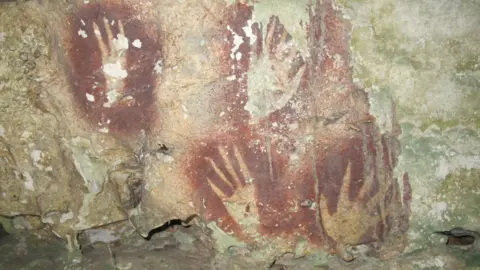
Researchers have found a remarkable red hand stencil on the island of Sulawesi that dates back 67,800 years, making it the oldest cave painting known. This finding suggests that human symbolic expression occurred much earlier than previously thought, supporting theories that our ancestors traveled to the Sahul landmass (now Australia and New Guinea) far earlier than assumed. The discovery challenges the traditional view that creativity burst forth primarily in Ice Age Europe, revealing instead an early and rich tradition of symbolic art in other parts of the world.
A stencilled outline of a hand found on the Indonesian island of Sulawesi is considered the world's oldest known cave painting, researchers say. It showcases a red outline of a hand whose fingers were manipulated to create a claw-like motif, signaling an early leap in symbolic thought. Dated at least 67,800 years ago, this artwork predates the previously recognized record of hand stencils in Spain by about 1,100 years.This finding bolsters arguments that Homo sapiens reached the broader Australia-New Guinea region, known as Sahul, much earlier than previously understood. Over the past ten years, discoveries in Sulawesi have contradicted the notion that art and complex thinking emerged solely during the Ice Age in Europe.Cave art signifies a pivotal moment when humans began to think abstractly, reflecting capabilities associated with language, religion, and science. According to Professor Adam Brumm, a lead researcher from Griffith University, this discovery supports the idea that creativity is an inherent characteristic of humans, predating the Eurocentric narrative that once dominated our understanding of human evolution.The hand stencil from Liang Metanduno, found in a limestone cave on Muna Island near Sulawesi, was created using an early form of graffiti where pigment was blown around a pressed hand. This stencil not only represents an artistic endeavor but also highlights advanced manipulation of form—the fingers were reshaped to create a distinct appearance.Earlier representations of cave art in Sulawesi trace back over 40,000 years, and as research progresses, it is clear that the practice of cave art was robust and widespread, demonstrating that symbolic thought was ingrained in human culture long before the Ice Age.Researchers argue that Sulawesi's location as a gateway between Asia and ancient Sahul has crucial implications for human migration, reinforcing proof that sophisticated artwork existed in this region well ahead of the long-accepted dates for the arrival of modern humans in Australia and New Guinea. This emerging perspective reshapes our understanding of early human creativity and cultural development.