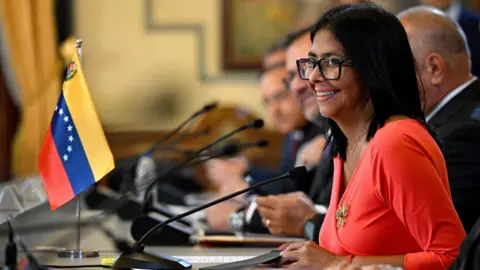
Human rights groups in Venezuela have criticized interim President Delcy Rodríguez for saying a scheme to release political prisoners was coming to an end, having been in place for just nine weeks. Nearly 500 political prisoners have been released under the amnesty law brought in by the country's National Assembly, prisoner rights group Foro Penal says, but many more are thought to still be in jail.
The group said Rodríguez lacked the power to end the releases, while watchdog Provea called the move arbitrary and unconstitutional. Despite being a lieutenant of former President Nicolás Maduro, Rodríguez has enjoyed the support of Donald Trump since US forces seized Maduro in January.
The US president surprised many by backing Rodríguez over opposition leader María Corina Machado, and the release of political prisoners - including Machado's colleagues - was a key concession to the US by the interim administration. The president of the National Assembly Jorge Rodríguez - Delcy's brother - initially announced the law, noting that 1,557 political prisoners had applied for amnesty, with an aim to cover 11,000 people.
Foro Penal highlighted that, as of April 20, 473 people identified as political prisoners had been released, while over 500 are thought to still be behind bars. In a meeting of justice officials in Caracas, Delcy Rodríguez stated that 8,616 people had been freed under the amnesty law and described it as being very successful in terms of its scope and the number of beneficiaries.
She added that for cases not covered by the law, there are other avenues through which they can be addressed. However, Foro Penal vice-president Gonzalo Himiob noted that another legislative act or referendum would be required to undo the amnesty law, which had no expiration date. Critics echoed these concerns, stating that ending the releases contradicts the pursuit of coexistence and political peace.
Maduro's regime has historically utilized political imprisonment to silence dissent and restrict opposition. Rodríguez has attempted to frame her interim government as fostering more political dissent, seeking favor with the US. Analysts suggest that Trump’s backing of her over Machado reflects a choice for stability over democratic principles in the region. Meanwhile, critics lament that genuine dialogue about democratic elections has been scarce since the upheaval of Maduro's government.
The group said Rodríguez lacked the power to end the releases, while watchdog Provea called the move arbitrary and unconstitutional. Despite being a lieutenant of former President Nicolás Maduro, Rodríguez has enjoyed the support of Donald Trump since US forces seized Maduro in January.
The US president surprised many by backing Rodríguez over opposition leader María Corina Machado, and the release of political prisoners - including Machado's colleagues - was a key concession to the US by the interim administration. The president of the National Assembly Jorge Rodríguez - Delcy's brother - initially announced the law, noting that 1,557 political prisoners had applied for amnesty, with an aim to cover 11,000 people.
Foro Penal highlighted that, as of April 20, 473 people identified as political prisoners had been released, while over 500 are thought to still be behind bars. In a meeting of justice officials in Caracas, Delcy Rodríguez stated that 8,616 people had been freed under the amnesty law and described it as being very successful in terms of its scope and the number of beneficiaries.
She added that for cases not covered by the law, there are other avenues through which they can be addressed. However, Foro Penal vice-president Gonzalo Himiob noted that another legislative act or referendum would be required to undo the amnesty law, which had no expiration date. Critics echoed these concerns, stating that ending the releases contradicts the pursuit of coexistence and political peace.
Maduro's regime has historically utilized political imprisonment to silence dissent and restrict opposition. Rodríguez has attempted to frame her interim government as fostering more political dissent, seeking favor with the US. Analysts suggest that Trump’s backing of her over Machado reflects a choice for stability over democratic principles in the region. Meanwhile, critics lament that genuine dialogue about democratic elections has been scarce since the upheaval of Maduro's government.