In brief
In Gaza City, children have begun attending school again after years of conflict. Makeshift classrooms are lively but face numerous challenges, including limited resources and trauma due to past violence. Despite these hurdles, students like Naeem and Rital express the significance of returning to a learning environment. With over 97% of schools damaged in the war, the return to education offers a glimpse of childhood for many children deprived of formal education.
In Gaza City, the sound of children learning can be heard once again.
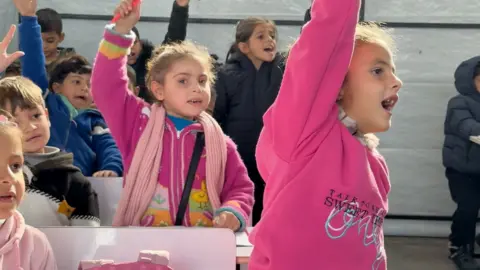
The tents that now serve as classrooms are noisy and a little chaotic but lively. Some teachers point to boards covered in English letters; others invite pupils to come forward and write basic Arabic words.
It is nowhere near a normal school day. But after the Israel-Hamas ceasefire in October, it's a start.
After two years of war, the hum of lessons and chatter of classmates resonates around the ruins of what was once Lulwa Abdel Wahab al-Qatami School, in the Tel al-Hawa neighbourhood in the south-western part of Gaza City.
It was hit in January 2024, and for months afterwards, its grounds served as a shelter for displaced families. Today, it is again a place of learning - albeit in a more basic form.
Walking in a straight line, their small arms resting on each other's shoulders, pupils smile as they head into the makeshift classrooms.
For many, this is the first return to routine and education since the war began.
According to Unicef, more than 97% of schools in Gaza were damaged or destroyed during the war. The IDF has made repeated claims that Hamas uses civilian infrastructure including schools to carry out operations but has rarely provided solid evidence.
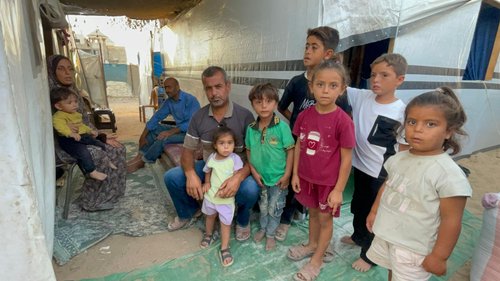
Of the Strip's 658,000 school-aged children, most have had no formal education for nearly two years. During that time, many learned first-hand how hunger, displacement and death can shape their young lives. Now, something rare is emerging: a fragile glimpse of the childhoods they once knew.
Despite the sea of challenges, children are determined to learn and reclaim their childhood, even if in temporary conditions. Teachers like Kholoud Habib emphasize the importance of education as a foundation for the future, recognizing the trauma many students face.
As Gaza begins to emerge from a turbulent period, schools like these are crucial in helping children rebuild their lives, one lesson at a time.