An impending crisis over conscripting ultra-Orthodox Jews into the Israeli army is threatening to undermine Israel's government and split the country. Public opinion on the issue has shifted dramatically in Israel after two years of war, and this is now perhaps the most explosive political risk facing Prime Minister Benjamin Netanyahu. Lawmakers are currently considering a draft bill to end the exemption granted to ultra-Orthodox men enrolled in full-time religious study, established when the State of Israel was declared in 1948. That exemption was ruled illegal by Israel's High Court of Justice almost 20 years ago. Temporary arrangements to continue it were formally ended by the court last year, forcing the government to begin drafting the community. Some 24,000 draft notices were issued last year, but only around 1,200 ultra-Orthodox - or Haredi - draftees reported for duty, according to military testimony given to lawmakers.
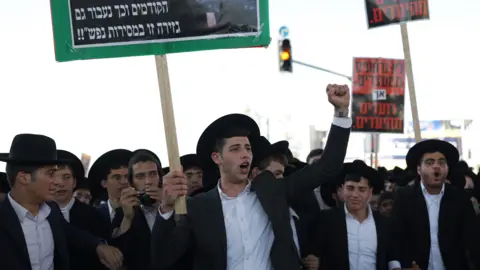
Tensions are erupting onto the streets, with lawmakers now debating a new draft bill to force ultra-Orthodox men into military service alongside other Israeli Jews. Two Haredi politicians were targeted this month by some extreme ultra-Orthodox protesters, who are furious with parliament's discussion of the proposed law. Last month, a vast protest by tens of thousands of Haredi men took place in Jerusalem, reflecting the wider conflict around the identity of the Jewish state, and the place of religion within it.
Support for extending the draft is rising among the Israeli public, and the ultra-Orthodox population has grown significantly in recent decades, leading to increasing pressure on the government to address military service discrepancies. Netanyahu's current efforts to modify the draft law have sparked significant political controversy and concerns over its potential failure to address the ongoing tensions.
Tensions are erupting onto the streets, with lawmakers now debating a new draft bill to force ultra-Orthodox men into military service alongside other Israeli Jews. Two Haredi politicians were targeted this month by some extreme ultra-Orthodox protesters, who are furious with parliament's discussion of the proposed law. Last month, a vast protest by tens of thousands of Haredi men took place in Jerusalem, reflecting the wider conflict around the identity of the Jewish state, and the place of religion within it.
Support for extending the draft is rising among the Israeli public, and the ultra-Orthodox population has grown significantly in recent decades, leading to increasing pressure on the government to address military service discrepancies. Netanyahu's current efforts to modify the draft law have sparked significant political controversy and concerns over its potential failure to address the ongoing tensions.