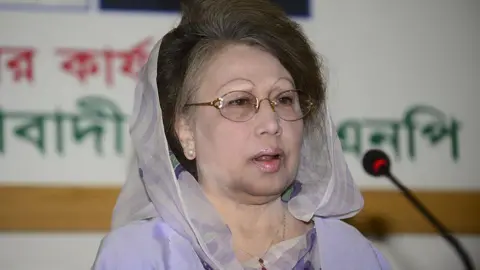
Khaleda Zia, who has died at the age of 80, was Bangladesh's first female prime minister. Her husband, Ziaur Rahman, a leading figure in the country's struggle for independence, was president in 1977. At the time, Ms Zia was described as a 'shy housewife' devoted to their two sons. But, following her husband's assassination in 1981, she rose to lead his Bangladesh Nationalist Party (BNP) and served two terms as prime minister - first in the 1990s and then in the early 2000s. In the brutal world of Bangladeshi politics, she was accused of corruption and spent years in prison - but the charges were dropped after a 2024 uprising that saw her long-time rival, Sheikh Hasina, swept from power. Khaleda Zia was born in West Bengal in 1945 and moved to what is now Bangladesh with her family after the partition of India. At 15, she married Ziaur Rahman, who declared independence for Bangladesh in 1971. Ms Zia became vice chairman of the BNP, eventually leading it to become the largest party in post-military elections, where she made primary school free and mandatory for all. Throughout her political career, she faced numerous challenges, including imprisonment and corruption charges, yet her legacy remains impactful, advocating for women and education.
Khaleda Zia: From 'Shy Housewife' to Bangladesh's First Female Prime Minister
Khaleda Zia: From 'Shy Housewife' to Bangladesh's First Female Prime Minister
Khaleda Zia, Bangladesh's first female Prime Minister, passed away at 80. Her journey from a dedicated housewife to a political powerhouse showcased resilience amidst challenges.
Khaleda Zia, remembered as Bangladesh's first female Prime Minister, passed away at 80 after a significant political career marked by challenges. Initially viewed as a 'shy housewife,' she entered politics following her husband's assassination in 1981, leading the Bangladesh Nationalist Party and serving as Prime Minister from 1991 to 1996 and 2001 to 2006. Despite facing prison time and corruption allegations, her political legacy includes pioneering education reforms and advocating for women's rights. Zia's story reflects the resilience and complexity of her role in Bangladeshi politics.