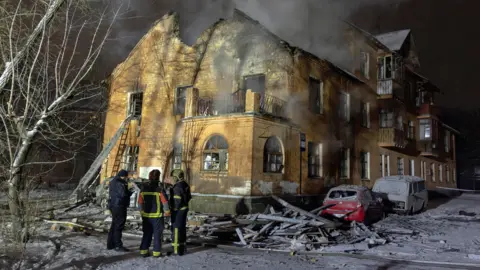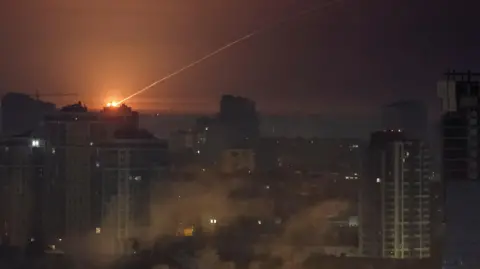
A large Russian aerial strike on Ukraine has again left half of Kyiv's residential buildings without heating or power as temperatures across the country continue to hover around -10C.
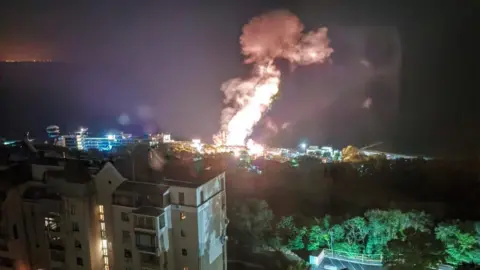
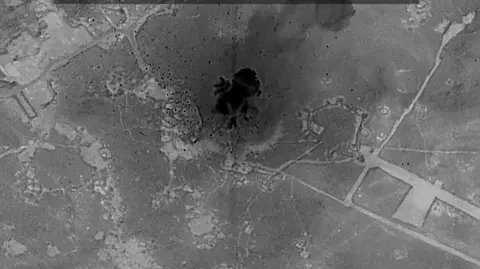
Drones, ballistic and cruise missiles targeted several locations in Ukraine, including Kyiv, Dnipro in the centre and Odesa in the south.
Air raid alerts in the capital lasted for most of the night. On Tuesday, sirens rang out again as Russian drones and cruise missiles approached the capital.
President Volodymyr Zelensky said a significant number of targets had been intercepted. But he also said that, in terms of air defence missile prices alone, repelling that attack had cost Ukraine about €80m (£69m).
Between Monday and Tuesday, at least four people died and 33 others were injured in strikes across Ukraine.
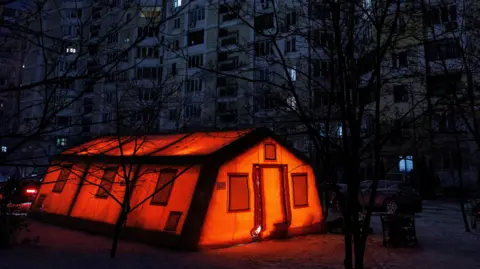
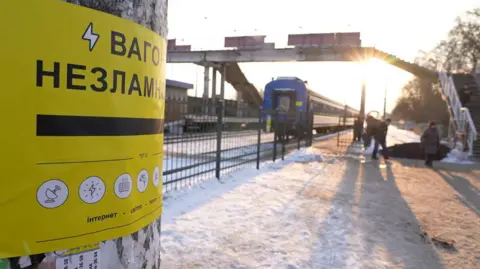
On Tuesday morning, more than 5,600 residential buildings – each with dozens of flats – in Kyiv woke up to no heating. A large part of the capital also has no water.
Mayor Vitalii Klitschko said almost 80% of those buildings had just had their heating restored following the large-scale attack on 9 January, which knocked out power for much of the city. Since then, relentless efforts by technicians had managed to reinstate electricity and gas for thousands - only for that work to be undone overnight.
I have no electricity and no water, Oleksandr Palii, a 29-year-old veteran, told the BBC. I didn't sleep until 3am because of the strikes either – there were explosions all night.
The Ukrainian president had been due to travel to the World Economic Forum in Davos, Switzerland, on Tuesday but, in the wake of the overnight strikes, he said he had decided to stay in Kyiv.
Temperatures have stayed well below freezing since the start of the year. Ukrainian media has reported instances of radiators bursting due to the water in them freezing, leading to flooding in entire buildings. There have also been reports of fires starting due to people using gas heaters indoor.
As the power cuts continue, Kyiv residents are finding innovative solutions to carry on living. Many now use portable stoves to cook, and entire buildings chip in to buy generators. But much depends on individual financial capacities.
I think people who are less well-off are coping much worse, says Olha Zasiadvovk, who has a young child.
The Kyiv city administration said more than 10,000 people, including nearly 800 children, took refuge in the city's metro stations on Monday night.
Foreign Minister Andrii Sybiha emphasized the importance of ending the war, stating, The resilience of the Ukrainian people cannot be an excuse for this war to continue. It must end as soon as possible.
As the situation remains critical, President Zelensky reiterated the need for enhanced air defense systems from global partners to protect his country from ongoing threats.