In brief
The passing of Sir Mark Tully, the esteemed BBC correspondent, has sparked an outpouring of tributes in India. Recognized as a key figure in journalism, Tully's reporting chronicled pivotal moments in South Asia's history, resonating deeply with audiences. Leaders and friends remember him as a formidable voice and a beloved figure, with many recalling his significant impact on their lives.
Tributes have been pouring in for veteran BBC journalist Sir Mark Tully who has been cremated in the Indian capital, Delhi, a day after he died at the age of 90.
Hundreds of people - including friends and family - gathered at the Lodhi crematorium to bid their final goodbye to the broadcaster.
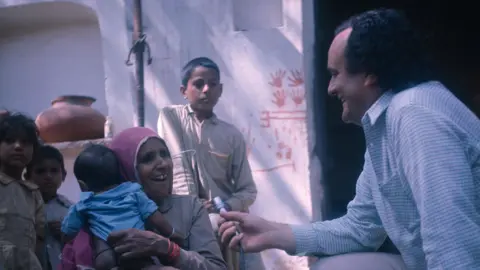
Sir Mark was widely regarded as the BBC's voice of India and was one of the most admired foreign correspondents of his generation.
India's Prime Minister Narendra Modi described Sir Mark as a towering voice of journalism, adding that his connect with India and the people of our nation was reflected in his works.
On Monday afternoon, mourners lined up around Sir Mark's body at the crematorium.
Wrapped in a white cloth, his body was laid on a platform on a bed of flowers, made up of rose petals and tuberoses. Marigold garlands and a wreath were placed on top.
Christian priests recited prayers and hymns were sung, before the body was taken for cremation.
Sir Mark, who died on Sunday at a Delhi hospital where he was undergoing treatment, has been described as a chronicler of modern India.
Over a career spanning several decades, he reported on big historical moments that defined South Asia's trajectory, such as the Indian army's storming of the Sikh Golden Temple and the birth of Bangladesh.
Journalist Satish Jacob, who worked closely with Sir Mark at the BBC for nearly two decades, shared fond memories, recalling their celebrations during India's Cricket World Cup victory.
Not only did he shape public perception through his storied career, but his influence extended into personal lives, as many Indian citizens tuned in to his broadcasts for credibility during turbulent times.
Sir Mark, knighted for his contributions to journalism, received two of India's highest civilian honors - the Padma Shri and Padma Bhushan, rare for foreign nationals.