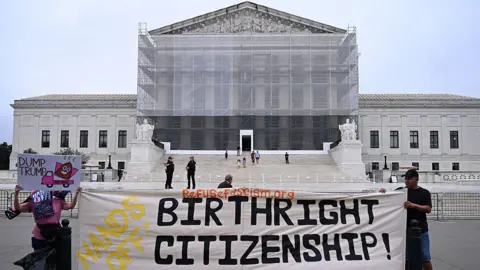
WASHINGTON (AP) — The Supreme Court has agreed to hear a case challenging the constitutionality of President Donald Trump's birthright citizenship order, which states that children born to parents in the U.S. illegally or temporarily are not American citizens. This order is part of the Trump administration's broader immigration policy and has faced significant opposition in lower courts setting the stage for a critical Supreme Court ruling. The case is set to be argued in the spring, with a definitive decision expected by early summer.
Supreme Court to Decide on Trump's Birthright Citizenship Policy
The Supreme Court will hear arguments over President Trump's order that seeks to limit birthright citizenship for children born in the U.S. to undocumented parents.
In a landmark case, the Supreme Court has agreed to review the constitutionality of President Trump's birthright citizenship order, which denies citizenship to children born to parents without legal status in the U.S. This case comes after lower courts ruled against the policy, citing it as a potential violation of the 14th Amendment, which has provided citizenship to anyone born on U.S. soil for over a century. Legal perspectives vary, with some arguing that the amendment was never meant to confer citizenship to children of noncitizens. The Supreme Court is expected to hear the case in the spring, with a ruling likely by summer.