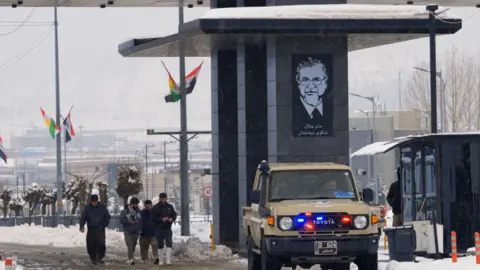
At the border crossing from Iran into Iraqi Kurdistan, the stern face of Iran's former supreme leader, Ayatollah Khomeini, peers down at the trickle of Iranians leaving the territory. Thick snowflakes confetti the lorries and pedestrians arriving at this remote mountain pass. Metres away, just beyond the border post, an Iranian flag flutters in the snow.
Iran has shut down the internet and blocked phone calls into the country, but its borders are still open. Inside the arrivals hall, we find dozens of men, women and children – many arriving to visit family on the Iraqi side of the border.
No-one we met said they were fleeing Iran because of the recent protests and government crackdown, but one man – who asked us to hide his identity – told us security forces had shot him during a protest in central Iran last Friday. I was hit in the face by seven pellet rounds, he said, pointing out several weals and bruises on his face. They struck above my eyelid, on my forehead, my cheek, my lip, under my ear and along my jaw. I had to use a razor blade to cut one of the pellets out.
He told us he was too afraid of being arrested to get medical help, and that others injured during the government crackdown on protestors were also avoiding treatment, out of fear that security forces would arrive and arrest them.
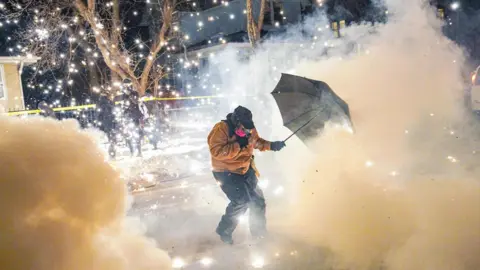
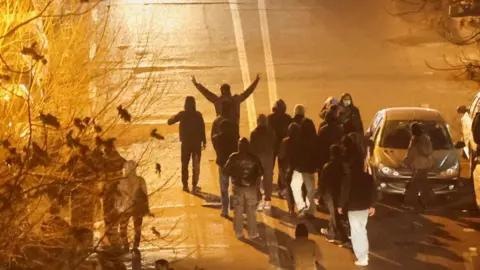
Rights groups say around 2,500 people have been killed due to the regime's violent response to protests. Despite the government’s attempts to quell demonstrations, reports suggest protests have continued, particularly in areas like Fardis and Malard.
Another individual indicated he witnessed protests in Tehran, though the true size and nature of these protests remain difficult to confirm due to the restriction on media reporting inside Iran. As the government imposes its control, fears linger over the lack of basic rights, economic sufficiency, and the ongoing repression of civil liberties.
Iran has shut down the internet and blocked phone calls into the country, but its borders are still open. Inside the arrivals hall, we find dozens of men, women and children – many arriving to visit family on the Iraqi side of the border.
No-one we met said they were fleeing Iran because of the recent protests and government crackdown, but one man – who asked us to hide his identity – told us security forces had shot him during a protest in central Iran last Friday. I was hit in the face by seven pellet rounds, he said, pointing out several weals and bruises on his face. They struck above my eyelid, on my forehead, my cheek, my lip, under my ear and along my jaw. I had to use a razor blade to cut one of the pellets out.
He told us he was too afraid of being arrested to get medical help, and that others injured during the government crackdown on protestors were also avoiding treatment, out of fear that security forces would arrive and arrest them.
Rights groups say around 2,500 people have been killed due to the regime's violent response to protests. Despite the government’s attempts to quell demonstrations, reports suggest protests have continued, particularly in areas like Fardis and Malard.
Another individual indicated he witnessed protests in Tehran, though the true size and nature of these protests remain difficult to confirm due to the restriction on media reporting inside Iran. As the government imposes its control, fears linger over the lack of basic rights, economic sufficiency, and the ongoing repression of civil liberties.