In brief
As demand for data storage soars, companies like Lonestar aim to harness the power of space, providing secure solutions beyond Earth's challenges.
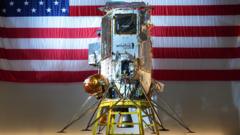
Recent developments have revealed ambitious plans by Lonestar Data Holdings to establish data centers on the Moon, a project that may sound like it’s pulled straight from a sci-fi novel. Stephen Eisele, president of Lonestar, argues that moving data processing off-planet not only enhances security but also taps into renewable solar energy for power. In a significant milestone, Lonestar tested a compact data center, equivalent to the size of a hardback book, aboard the Athena Lunar Lander, launched by SpaceX. This advancement is crucial; data centers are essential facilities that manage vast quantities of data for businesses and governments but are often hindered by limitations on Earth. As the demand for data continues to climb—predicted to increase by up to 22% by 2030—finding suitable terrestrial locations for these centers has become increasingly challenging. Locals frequently oppose new data centers due to their environmental impact, as they consume massive amounts of energy and require cooling systems. The shift to space-based data storage could alleviate these concerns, leveraging solar energy and eliminating conflicts with neighbors. This space journey isn't just a theoretical concept; reports like Thales Alenia Space's Ascend indicate that orbital data centers could revolutionize Europe’s digital economy. They propose a constellation of satellites designed to manage data processing efficiently in space, thus reducing ecological footprints. However, challenges remain, including the high cost of launches, complex cooling needs in microgravity, and risks from space debris.Experts warn that making this vision a reality requires not just optimism but substantial investment in technology and infrastructure. Still, the demand is apparent, with organizations like Lonestar already eyeing contracts with governments. Their aim is to put a data center in orbit by 2027, while other companies like Starcloud are racing to accelerate the timeline. With the distance to the Moon providing added security, Lonestar suggests that their data centers could operate akin to "vaults in space," secure from terrestrial threats, adhering to data sovereignty laws. This innovation represents an exciting chapter in tech, combining exploration with cutting-edge data solutions.