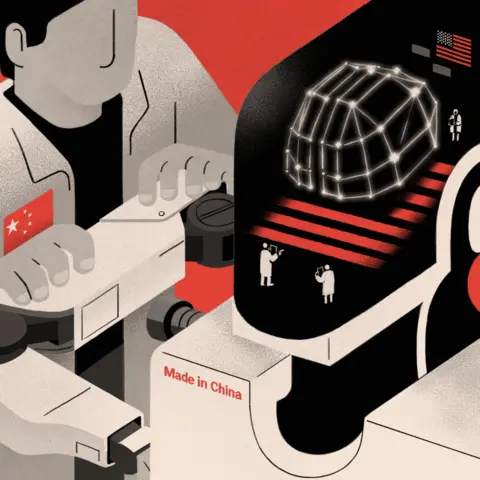
In the second half of the 20th Century, it was the race to develop nuclear arms that occupied some of the finest minds in the US and the Soviet Union. Now the US finds itself in a different kind of race with a different adversary: China. The aim is to dominate technology; specifically Artificial Intelligence (AI).
This competition takes place in research labs, on university campuses, and in the offices of start-ups, with billions of dollars at stake. Both nations boast unique advantages: the US's strength lies in AI brains, like chatbots and microchips, while China leads in AI bodies, such as humanoid robots.
After the launch of OpenAI's ChatGPT, the US took a significant lead in AI brains. ChatGPT's popularity surged, with 900 million users a week. However, China struck back with DeepSeek, a chatbot that closely rivals ChatGPT and is comparatively cheaper to produce, demonstrating that it too can develop advanced AI systems.
Despite China's advances, it remains behind in the manufacturing of high-end microchips, essential for powerful AI operations. The US maintains a strict control over semiconductor technology, preventing China from accessing these resources. The battle has significant implications, not just for the technologies at stake, but also for global economic and political dominance.
In the realm of robotics, China excels with its substantial investments in robot development and production. With around 90% of humanoid robot exports coming from China, the country integrates robotics into everyday life. This competitiveness ensures that while China may be behind in AI brains, it is a leader in AI bodies and has ambitions for complete self-reliance in future AI applications.
As both nations refine their strategies, the AI race is not just about immediate victories. It involves establishing standards and sustaining advantages that will dictate the global technological landscape. The ultimate victor could redefine the balance of power in the coming century.