
In brief
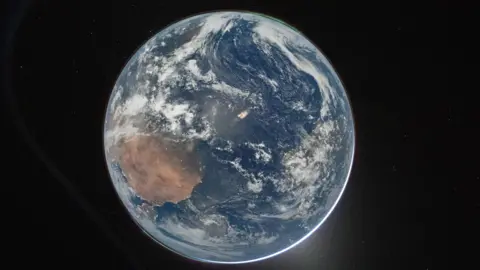
NASA's Artemis II crew is halfway to the Moon and has shared stunning high-resolution images of Earth. After completing a critical engine burn, they expressed joy at this milestone. The images, featuring the blue Atlantic Ocean and the Earth divided by night and day, highlight the beauty of our planet as seen from space. The mission is historic as it marks humanity's return to lunar exploration, aiming to circle the Moon and return to Earth by April 10, 2026.
NASA has shared the first high-resolution images of the Earth taken by the Artemis II crew as they pass the halfway point between the Earth and the Moon. The mission's commander, Reid Wiseman, took the 'spectacular' images after the crew completed a final engine burn that set them on a trajectory towards our closest celestial neighbor. As of the latest update, the Orion spacecraft was approximately 142,000 miles from Earth and 132,000 miles from the Moon. Astronaut Christina Koch expressed their collective 'joy' at the achievement, which they reached around 2 days and 5 hours post-launch.One of the images, titled 'Hello, World,' beautifully captures the Atlantic Ocean, highlighted with a glow from the atmosphere, as the Earth eclipses the Sun and shows green auroras at the poles. The Earth appears inverted in the image, revealing the western Sahara and Iberian Peninsula on the left and South America's eastern part on the right. NASA identified a bright dot representing Venus in the image. The crew took several more photos, mesmerized by the views outside the windows of the Orion spacecraft. They are now on a looping path that will carry them around the far side of the Moon, marking the first time humans have ventured beyond Earth's orbit since 1972. After launching from Kennedy Space Center in Florida, the crew is expected to pass the Moon's far side on April 6 and return to Earth on April 10 with a splashdown in the Pacific Ocean.