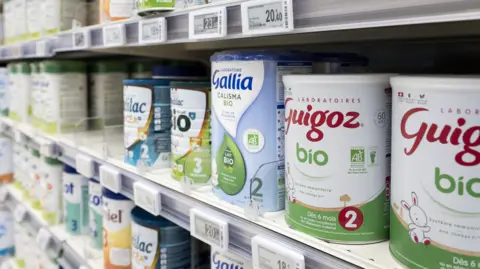
Prosecutors in Paris have opened investigations into five baby formula manufacturers after several issued mass recalls over concerns their product contained a toxin. Nestle, Lactalis, Danone, Babybio, and La Marque en moins will be probed over whether there was any criminal wrongdoing in distributing baby formula that may have been contaminated with cereulide.
French authorities have received complaints from eight individuals who reported their child vomited after consuming baby formula. Last week, Nestle and Danone issued recalls in more than 60 countries, including the UK, over potentially contaminated batches.
At least 36 infants in the UK have suffered from suspected food poisoning after consuming baby formula, officials have said. Cereulide is a toxin which is unlikely to be destroyed through cooking or when making baby milk. If consumed, it can cause nausea, vomiting, and abdominal cramps.
The toxin in baby formula was linked to an ingredient called arachidonic acid (ARA) oil, which gives it similar growth properties as breast milk. The UK Food Standards Agency (FSA) earlier stated that a third-party supplier of ARA was the source of the contamination and is no longer being used.
That supplier is widely believed to be the Chinese company Cabio Biotech, based in Wuhan. On Thursday, China's national market regulator informed domestic baby formula manufacturers to test for cereulide, without naming specific companies.
Prosecutors in Paris will investigate whether the manufacturers are liable for distributing tainted products. They will coordinate with local probes into the deaths of three babies in France, although Nestle and France's health ministry have stressed there is currently no evidence connect these cases to contaminated formula.
So far, 28 batches of baby formula produced by Nestle and Danone have been recalled. Both companies assured the FSA that the recalled products were produced some time ago and were unlikely to still be available in UK shops.
However, some may still be in homes, prompting parents and caregivers to check their supplies. Nestle has announced its plan to operate five factories around the clock to increase baby formula production following the global recall, boasting its commitment to providing high-quality products that families can trust.
French authorities have received complaints from eight individuals who reported their child vomited after consuming baby formula. Last week, Nestle and Danone issued recalls in more than 60 countries, including the UK, over potentially contaminated batches.
At least 36 infants in the UK have suffered from suspected food poisoning after consuming baby formula, officials have said. Cereulide is a toxin which is unlikely to be destroyed through cooking or when making baby milk. If consumed, it can cause nausea, vomiting, and abdominal cramps.
The toxin in baby formula was linked to an ingredient called arachidonic acid (ARA) oil, which gives it similar growth properties as breast milk. The UK Food Standards Agency (FSA) earlier stated that a third-party supplier of ARA was the source of the contamination and is no longer being used.
That supplier is widely believed to be the Chinese company Cabio Biotech, based in Wuhan. On Thursday, China's national market regulator informed domestic baby formula manufacturers to test for cereulide, without naming specific companies.
Prosecutors in Paris will investigate whether the manufacturers are liable for distributing tainted products. They will coordinate with local probes into the deaths of three babies in France, although Nestle and France's health ministry have stressed there is currently no evidence connect these cases to contaminated formula.
So far, 28 batches of baby formula produced by Nestle and Danone have been recalled. Both companies assured the FSA that the recalled products were produced some time ago and were unlikely to still be available in UK shops.
However, some may still be in homes, prompting parents and caregivers to check their supplies. Nestle has announced its plan to operate five factories around the clock to increase baby formula production following the global recall, boasting its commitment to providing high-quality products that families can trust.