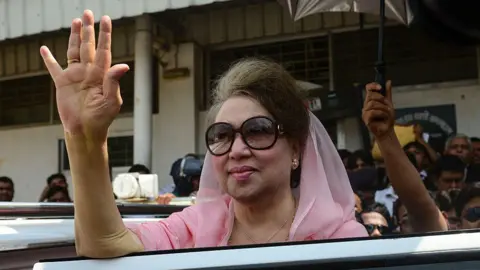
Khaleda Zia, Bangladesh's first female prime minister and an arch-rival of ousted leader Sheikh Hasina, has died from a prolonged illness. She was 80 years old. Zia intended to run for parliament in February, when the country will vote for the first time since a popular revolution in late 2024 unseated Hasina.
Thrust into the political limelight following the assassination of her husband, then-president Ziaur Rahman, she went on to become Bangladesh's first female PM in 1991. Her career, which included spells in prison and house arrest, was defined by a bitter feud with Hasina. She was acquitted of corruption and allowed to travel to London for treatment only after Hasina lost power.
Physicians said on Monday that Zia's condition was extremely critical. She was put on life support, but it was not possible to provide multiple treatments at the same time given her age and overall poor health. Our favourite leader is no longer with us. She left us at 6 am this morning, Zia's Bangladesh Nationalist Party (BNP) announced on Facebook on Tuesday.
Crowds gathered outside Evercare Hospital in Dhaka where Zia had been admitted to mourn her passing. Known for her uncompromising leadership style, Zia broke through a male-dominated political landscape and transformed into one of Bangladesh's most formidable political figures, advocating for women's education and social development during her tenure.
Despite health issues keeping her away from public life, Zia remained a figurehead for opposition forces, with many regarding her as a symbol of democracy in Bangladesh. After 16 years under the Awami League government, Zia became the most prominent resistance against Hasina's increasingly autocratic rule.
Her legacy will be remembered not just through her political battles but also in her advocacy for the rights of the people and the democratic movement in Bangladesh.
Thrust into the political limelight following the assassination of her husband, then-president Ziaur Rahman, she went on to become Bangladesh's first female PM in 1991. Her career, which included spells in prison and house arrest, was defined by a bitter feud with Hasina. She was acquitted of corruption and allowed to travel to London for treatment only after Hasina lost power.
Physicians said on Monday that Zia's condition was extremely critical. She was put on life support, but it was not possible to provide multiple treatments at the same time given her age and overall poor health. Our favourite leader is no longer with us. She left us at 6 am this morning, Zia's Bangladesh Nationalist Party (BNP) announced on Facebook on Tuesday.
Crowds gathered outside Evercare Hospital in Dhaka where Zia had been admitted to mourn her passing. Known for her uncompromising leadership style, Zia broke through a male-dominated political landscape and transformed into one of Bangladesh's most formidable political figures, advocating for women's education and social development during her tenure.
Despite health issues keeping her away from public life, Zia remained a figurehead for opposition forces, with many regarding her as a symbol of democracy in Bangladesh. After 16 years under the Awami League government, Zia became the most prominent resistance against Hasina's increasingly autocratic rule.
Her legacy will be remembered not just through her political battles but also in her advocacy for the rights of the people and the democratic movement in Bangladesh.