US investigators will face a host of thorny questions in determining whether the fatal shooting of a woman by a federal agent in Minneapolis last week was justified, as local and national officials recount drastically different accounts of an incident that sparked nationwide protests.
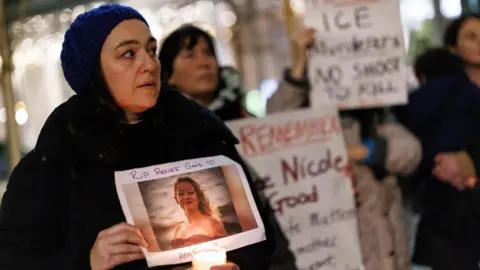
Several videos have emerged showing US Immigration and Customs Enforcement (ICE) agent Jonathan Ross firing at and killing Renee Good, 37, while she was behind the wheel of her burgundy Honda in a residential neighborhood of the northern city.
President Donald Trump and his administration have described Good as a 'domestic terrorist' who was trying to run over the ICE agent, while state officials have said Good, a mother of three, was trying to leave the scene.
Former law enforcement officials told the BBC that a review of the incident could plausibly find the agent was justified in using deadly force because he believed Good was a threat. But they said Trump officials' strong public statements in support of Ross in the immediate aftermath of the shooting could complicate the investigation.
When analyzing whether the ICE officer was justified in shooting Good, investigators will have to compare Ross's actions in the videos to the Department of Homeland Security's (DHS) policy on the use of deadly force. Former law enforcement agents said a previous episode in which Ross was injured on duty - as well as the quick determinations he had to make about the threat level - will likely be seen by federal investigators as providing that official justification.
Under DHS policy, agents are authorized to use deadly force if they believe they are at risk of death, imminent threat of death or grievous bodily harm. The case has become a politically charged situation, with calls for impartiality as evidence is evaluated. Local officials intend to conduct their own review amid concerns over federal biases in the investigation.
Several videos have emerged showing US Immigration and Customs Enforcement (ICE) agent Jonathan Ross firing at and killing Renee Good, 37, while she was behind the wheel of her burgundy Honda in a residential neighborhood of the northern city.
President Donald Trump and his administration have described Good as a 'domestic terrorist' who was trying to run over the ICE agent, while state officials have said Good, a mother of three, was trying to leave the scene.
Former law enforcement officials told the BBC that a review of the incident could plausibly find the agent was justified in using deadly force because he believed Good was a threat. But they said Trump officials' strong public statements in support of Ross in the immediate aftermath of the shooting could complicate the investigation.
When analyzing whether the ICE officer was justified in shooting Good, investigators will have to compare Ross's actions in the videos to the Department of Homeland Security's (DHS) policy on the use of deadly force. Former law enforcement agents said a previous episode in which Ross was injured on duty - as well as the quick determinations he had to make about the threat level - will likely be seen by federal investigators as providing that official justification.
Under DHS policy, agents are authorized to use deadly force if they believe they are at risk of death, imminent threat of death or grievous bodily harm. The case has become a politically charged situation, with calls for impartiality as evidence is evaluated. Local officials intend to conduct their own review amid concerns over federal biases in the investigation.