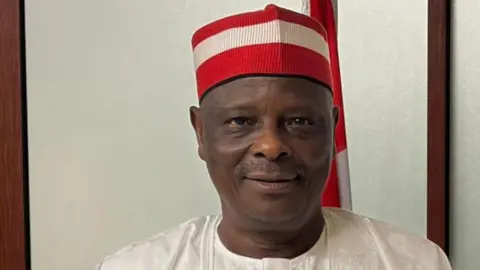
The coalition poised to challenge Nigeria's president in next year's election has received a major boost after prominent opposition figure Rabiu Musa Kwankwaso announced that he was joining the African Democratic Congress (ADC). Kwankwaso, a former governor of Kano state, made this announcement on Monday following his resignation from the New Nigeria People's Party (NNPP).
Notably, many leading opposition figures are joining the ADC in hopes of unseating President Bola Tinubu's All Progressives Congress (APC), which has held power since 2015. Among these figures are former Vice-President Atiku Abubakar and ex-state governor Peter Obi, who are emerging as the faces of the ADC.
Kwankwaso's candidacy in the 2023 elections resulted in a fourth-place finish, while Abubakar and Obi secured second and third places, respectively. The introduction of so many heavyweight politicians raises an important question for the ADC: who will become the presidential candidate, a dilemma that could result in divisions within the coalition.
In his announcement, Kwankwaso stated that he had chosen to leave the NNPP due to the need for a 'strategic realignment' aligned with the current political climate, expressing that he is now committed to the ADC as the political platform that best serves the nation's needs.
The ADC's recent influx of talent comes less than a year before Nigeria's general elections, with the ruling party already backing President Tinubu for a second term. With significant security concerns facing Nigeria, Kwankwaso's prior experience as a former defense minister may become a pivotal asset for the ADC.
Kwankwaso's supporters, known as the Kwankwasiyya movement, have shown unwavering loyalty, and the visual presence of this group, identifiable by their trademark red caps, signifies a formidable grassroots foundation for the ADC's campaign. As Kwankwaso celebrated with his supporters, the scene captured a hopeful moment for the future of opposition politics in Nigeria.
Additionally, internal conflicts within Nigeria’s main opposition groups, the People’s Democratic Party (PDP) and Labour Party (LP), have created a power vacuum that the ADC hopes to exploit. The PDP is currently divided into rival factions, weakening its traditional status as the largest opposition party. Meanwhile, the electoral commission has introduced reforms intended to improve the transparency of vote counting, though concerns remain regarding manual sorting protocols. Kwankwaso's transition to the ADC could significantly reshape the political landscape as Nigeria approaches this critical election.
Notably, many leading opposition figures are joining the ADC in hopes of unseating President Bola Tinubu's All Progressives Congress (APC), which has held power since 2015. Among these figures are former Vice-President Atiku Abubakar and ex-state governor Peter Obi, who are emerging as the faces of the ADC.
Kwankwaso's candidacy in the 2023 elections resulted in a fourth-place finish, while Abubakar and Obi secured second and third places, respectively. The introduction of so many heavyweight politicians raises an important question for the ADC: who will become the presidential candidate, a dilemma that could result in divisions within the coalition.
In his announcement, Kwankwaso stated that he had chosen to leave the NNPP due to the need for a 'strategic realignment' aligned with the current political climate, expressing that he is now committed to the ADC as the political platform that best serves the nation's needs.
The ADC's recent influx of talent comes less than a year before Nigeria's general elections, with the ruling party already backing President Tinubu for a second term. With significant security concerns facing Nigeria, Kwankwaso's prior experience as a former defense minister may become a pivotal asset for the ADC.
Kwankwaso's supporters, known as the Kwankwasiyya movement, have shown unwavering loyalty, and the visual presence of this group, identifiable by their trademark red caps, signifies a formidable grassroots foundation for the ADC's campaign. As Kwankwaso celebrated with his supporters, the scene captured a hopeful moment for the future of opposition politics in Nigeria.
Additionally, internal conflicts within Nigeria’s main opposition groups, the People’s Democratic Party (PDP) and Labour Party (LP), have created a power vacuum that the ADC hopes to exploit. The PDP is currently divided into rival factions, weakening its traditional status as the largest opposition party. Meanwhile, the electoral commission has introduced reforms intended to improve the transparency of vote counting, though concerns remain regarding manual sorting protocols. Kwankwaso's transition to the ADC could significantly reshape the political landscape as Nigeria approaches this critical election.