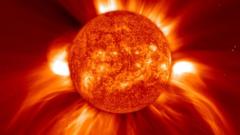
India has achieved a milestone in space exploration with the Aditya-L1 mission, its first dedicated solar observation project. Scientists announced the acquisition of pivotal data following the detection of a coronal mass ejection (CME) on July 16. The mission’s primary instrument, the Visible Emission Line Coronagraph (Velc), accurately recorded when the CME commenced, enhancing our comprehension of solar activities.
CMEs are colossal bursts of solar wind and magnetic fields rising above the solar corona or being released into space. These enormous fireballs can reach speeds of 3,000 km/h (1,864 mph) and weigh up to a trillion kilograms. An event where Velc tracked a CME revealed that it began its journey toward Earth but veered off-course, sparing our planet from its effects.
These solar phenomena can disrupt Earth’s magnetic field, potentially affecting communication systems, satellites, and power grids. The mission aims to predict these solar bursts to mitigate their chaotic consequences, as past instances have already impacted air traffic and power systems globally.
Aditya-L1 monitors the Sun continuously, allowing constant observation that isn't hindered by eclipses. It also works alongside India's three ground observatories, creating an enhanced understanding of solar phenomena. With Aditya-L1, India joins the ranks of established space agencies observing the Sun from space, significantly contributing to our understanding of solar activities and their implications for life on Earth.
CMEs are colossal bursts of solar wind and magnetic fields rising above the solar corona or being released into space. These enormous fireballs can reach speeds of 3,000 km/h (1,864 mph) and weigh up to a trillion kilograms. An event where Velc tracked a CME revealed that it began its journey toward Earth but veered off-course, sparing our planet from its effects.
These solar phenomena can disrupt Earth’s magnetic field, potentially affecting communication systems, satellites, and power grids. The mission aims to predict these solar bursts to mitigate their chaotic consequences, as past instances have already impacted air traffic and power systems globally.
Aditya-L1 monitors the Sun continuously, allowing constant observation that isn't hindered by eclipses. It also works alongside India's three ground observatories, creating an enhanced understanding of solar phenomena. With Aditya-L1, India joins the ranks of established space agencies observing the Sun from space, significantly contributing to our understanding of solar activities and their implications for life on Earth.