In brief
The latest research shows glaciers are losing ice faster than ever, with potential consequences for water resources and rising sea levels. If humanity continues to warm the planet, we could see alarming losses by the century's end.
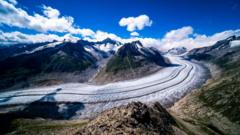
The world's glaciers are shrinking at a record pace due to climate change, according to a groundbreaking scientific study. Spanning over 20 kilometers, the Aletsch Glacier in the European Alps has receded more than 3.2 kilometers (2 miles) since 1900, with over a kilometer lost just since 2000. Mountain glaciers, crucial for providing freshwater to millions, store enough water to raise sea levels by 32 cm (13 inches) if they melted entirely. Since 2000, they've lost over 6,500 billion tonnes of ice, equating to 5% of their total mass, and the rate of melting is escalating. In the last decade, glacier losses have grown more than a third compared to the period from 2000-2011. This study, published in the journal Nature, integrated data from over 230 estimates across 35 research teams, validating how swiftly glaciers are disappearing. Glaciers reflect climate change; in a stable climate, they neither gain nor lose substantial ice. However, human activities, mainly fossil fuel consumption, have caused them to shrink dramatically in the past 20 years. On average, glaciers outside the Greenland and Antarctica ice sheets have lost around 270 billion tonnes of ice annually between 2000 and 2023. To put that in perspective, this represents the water consumption for the entire global population over 30 years, based on 3 liters per person per day. Areas in central Europe alone have seen a staggering 39% decrease in glacier ice within just over two decades.The study's significance lies not in revealing that glaciers are melting faster, but in consolidating evidence from diverse global research efforts. Scientists employ varied methods, from detailed field measurements to satellite observations, ensuring comprehensive understanding despite each method's limitations. These collective estimates bolster confidence in the findings, benefiting climate scientists, governments, industries, and concerned citizens.It's important to note that glaciers react to climate changes over time, with varying responses based on size, meaning melting will persist in the coming years. The extent of ice loss by the century's end hinges on humanity's carbon dioxide emissions and climate change mitigation efforts. Meeting climate targets could limit glacier ice loss to 25%, whereas unchecked warming could lead to a nearly 50% loss.The repercussions of glacier melt extend beyond local ecosystems; the disappearance of glaciers—essential water sources for millions—threatens global water supplies. As these icy reservoirs vanish, so too does the water they provide, increasing the risk of drought. Moreover, rising sea levels due to glacier and ice sheet melt lead to more frequent coastal flooding, with even slight increases in sea-level posing risks to millions. Since 1900, global sea levels have risen over 20 cm (8 inches), with half of that occurring since the early 1990s. Future decades are expected to see accelerated increases.