Colombia's President Gustavo Petro has told the BBC that he believes there is now a 'real threat' of US military action against Colombia.
Petro said the US is treating other nations as part of a US 'empire'. It comes after Trump said a military operation in Colombia 'sounds good'. Petro said that the US risks transforming from 'dominating the world' to becoming 'isolated from the world.'
He also accused US Immigration and Customs Enforcement (ICE) agents of acting like 'Nazi brigades'. Trump has significantly expanded ICE operations as part of what the administration says is a crackdown on crime and immigrants who illegally entered the US.
The BBC has approached the White House for comment.
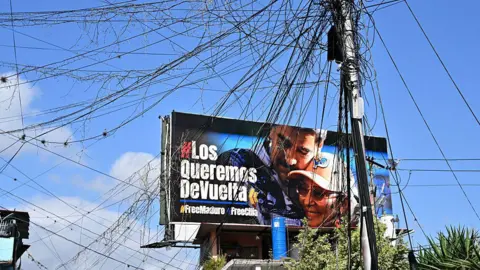
Following US strikes on Venezuela and the seizure of Nicolás Maduro, US President Donald Trump said a military operation targeting Colombia 'sounds good'.
Trump has also repeatedly told Petro to 'watch his ass', remarks Petro strongly condemned.
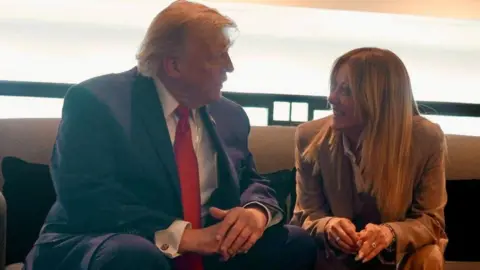
Trump and Petro spoke by phone on Wednesday evening, after which Trump said he would meet his Colombian counterpart at the White House in the 'near future'. Writing on his Truth Social platform late Wednesday after the call, Trump described his conversation with Petro as a 'Great Honour'. A Colombian official said at the time that the conversation had reflected a 180-degree shift in rhetoric 'from both sides.'
But on Thursday, Petro's tone suggested relations had not significantly improved.
He told the BBC the call lasted just under an hour, 'most of it occupied by me,' and covered 'drug trafficking in Colombia' and Colombia's view on Venezuela and 'what is happening around Latin America regarding the United States.'
Petro strongly criticised recent US immigration enforcement, accusing ICE agents of operating like 'Nazi brigades'.
Trump has accused countries like Colombia and Venezuela of not doing enough to tackle drug-trafficking.
The US has conducted more than 30 strikes in recent months on vessels that the US says were being used for drug trafficking in the Caribbean and the Pacific, killing more than 110 people.
Trump told Fox News host Sean Hannity that after targeting drug trafficking by water 'we are going to start now hitting land', adding that 'the cartels are running Mexico.'
Trump has often blamed immigration for crime and trafficking in the US, using it to justify large-scale enforcement operations.
Since returning to the White House, the US president has sent ICE agents to cities across the country. The agency enforces immigration laws and conducts investigations into undocumented immigration. It also plays a role in removing undocumented immigrants from the US.
This week a US immigration agent shot dead a 37-year-old US citizen in Minneapolis, sparking protests overnight. Federal officials stated the woman had tried to run over immigration agents with her car, but the city's mayor demanded agents leave, claiming the shooting was reckless.
Petro indicated that ICE had 'reached the point where it no longer only persecutes Latin Americans in the streets, which for us is an affront, but it also kills United States citizens.'
If this continues, he warned, 'instead of a United States dominating the world – an imperial dream – it is a United States isolated from the world. An empire was not built by being isolated from the world.'
Petro asserted that the US has treated other governments, particularly in Latin America, as an 'empire' for decades.
As the world's largest producer of cocaine, Colombia is a major hub for the global drug trade. It also has significant oil reserves, gold, silver, emeralds, platinum, and coal.
The US has pledged to control sales of Venezuelan oil 'indefinitely' as it prepares to roll back restrictions on crude oil in global markets.
Speaking aboard Air Force One after the intervention in Venezuela, Trump described Petro as a 'sick man who likes making cocaine and selling it to the United States,' adding: 'He's not going to be doing it for very long.'
Petro denied these claims, asserting that it has 'always been proven that I'm not involved in that'.
'For 20 years I have been fighting against the drug cartels, at the cost of my family having to go into exile,' he noted.
Petro has pursued a 'total peace' strategy since taking office, prioritising dialogue with armed groups. Critics claim this approach has been too lenient, considering record levels of cocaine production.
In response to questions about why his strategies have failed, Petro remarked that coca cultivation growth was slowing and described 'two simultaneous approaches': one involving peace talks with groups termed as bandits and the other concerning a military offensive against those unwilling to engage in peace.
He emphasized that negotiations were ongoing in southern Colombia, where the highest reduction in coca leaf cultivation has been noted alongside a significant decrease in homicide rates.
Petro confirmed conversations with Venezuela's acting president, Delcy Rodríguez, affirming that she was invited to Colombia. He pointed out Venezuela's long-standing subject to interference by various intelligence agencies and denounced other alleged 'covert operations' in Colombia.
He refrained from commenting directly on concerns about potential CIA operations in Colombia or the presence of spies within his own government.
Recently captured, Nicolás Maduro was apprehended by the US army's Delta Force, which was supported by a CIA source in the Venezuelan government.
In conclusion, Petro pointed out the imperative need for dialogue emphasizing Colombia's historical responses to military threats, while also asserting the reliance on geography and people over military might.