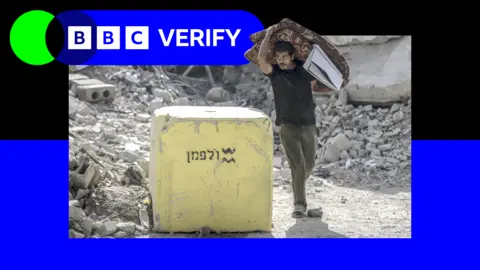
Israel has moved the blocks which are supposed to mark its post-ceasefire line of control deeper into Gaza in several places, sowing confusion among Palestinians.
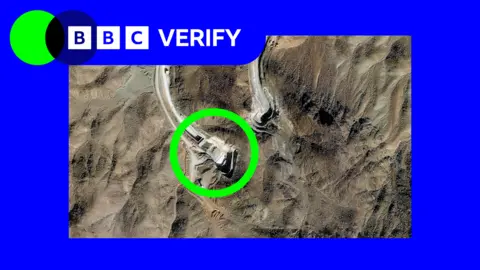
Satellite images reviewed by BBC Verify show that in at least three areas Israel placed blocks, before returning later and moving the positions further into the Strip.
Under the terms of the US-brokered deal with Hamas, Israel agreed to withdraw troops beyond a line marked in yellow on Israeli military maps, which it has illustrated on the ground with concrete yellow blocks.
Defence Minister Israel Katz warned in October that anyone crossing the Yellow Line would be met with fire.
Since these comments were made, there have been a series of deadly incidents around the line.
In Beit Lahia, Jabalia and al-Tuffah, the Israel Defense Forces (IDF) placed blocks and later returned to move them deeper inside Gaza. In total, 16 positions were moved.
In the al-Tuffah neighbourhood of Gaza City, satellite images show that IDF troops moved at least seven already placed blocks between 27 November and 25 December. The position of the markers were moved on average 295m (968ft) deeper inside the Strip.
While Israel agreed to withdraw its forces behind the Yellow Line under October's ceasefire deal, videos and satellite images have shown IDF vehicles operating beyond the mapped Yellow Line. Some sections remain unmarked on the ground, leaving residents uncertain about the designated dangerous zones.
One witness described the atmosphere as terrifying, with constant noises of artillery and a fear of being directly targeted. Experts have labeled the movements of these blocks as a strategy for territorial manipulation, affecting where Gaza residents can live, move, and farm.
Additionally, incidents of violence have occurred frequently since the Yellow Line was moved, leading to civilian casualties and heightened fears among the local populace.